
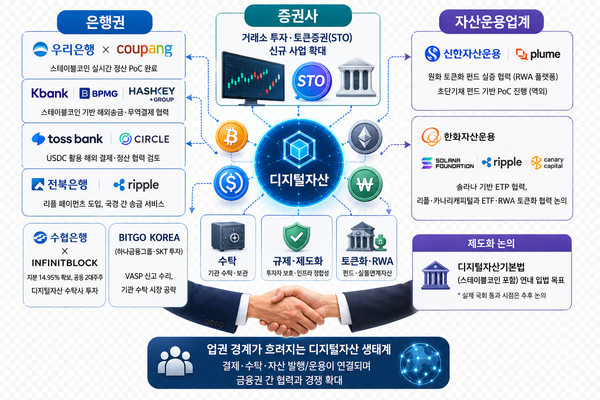
Financial companies are moving competitively to form digital asset alliances. As brokerages expand related businesses focused on investment in digital asset exchanges and token securities (STO), banks and asset managers are also speeding up tie-ups in digital assets.
On Aug. 26, Shinhan Financial Group recently signed a strategic business agreement with Visa for future financial businesses including digital assets.
Following executive-level talks in April, the two plan to use Visa's stablecoin platform to verify core functions such as issuance, remittance and redemption. They also plan to jointly design a business model suited to South Korea's financial environment.
Areas of cooperation also include using stablecoins for financial services such as card payment settlement, an artificial intelligence-based future payment model, and expanding business-to-business and business-to-consumer payment services.
Woori Bank and Coupang earlier completed a proof of concept for real-time settlement technology using a won-denominated stablecoin. They verified, in an environment identical to a commercial service, a process in which Coupang Eats order payments are remitted and settled in real time to merchants through stablecoins. Woori Bank took charge of building an on-and-off ramp linking an electronic wallet and a bank account to convert stablecoins and won.
K Bank has joined hands with blockchain firm BPMG and Hong Kong digital asset company HashKey Group. The three signed an agreement last month and are jointly reviewing overseas remittances and trade settlement using a won-denominated stablecoin, as well as digital asset custody, conversion and settlement technologies.
They are also pursuing a plan to connect HashKey's overseas network to a won-denominated stablecoin-based overseas payment proof of concept that K Bank and BPMG previously conducted in Thailand and the United Arab Emirates.
Toss and Toss Bank also signed a strategic business agreement last month with Circle, the issuer of the dollar stablecoin USD Coin (USDC). Toss is reviewing ways to use blockchain for digital wallets and payment and settlement infrastructure, while Toss Bank is exploring the possibility of cooperation in overseas payment and settlement infrastructure using stablecoins.
Jeonbuk Bank is also expanding its digital finance business into cross-border payments and remittances through a partnership with global blockchain company Ripple. On Aug. 18, Jeonbuk Bank signed a strategic partnership with Ripple and decided to be the first domestic bank to adopt Ripple's international payments solution, 'Ripple Payments.'
Moves by banks are expanding beyond technology verification to direct investment in digital asset custody companies.
Suhyup Bank signed an agreement with digital asset custodian Infinant Block on Aug. 20 and secured a 14.95 percent stake through an equity investment. As a result, Suhyup Bank became Infinant Block's joint second-largest shareholder.
Infinant Block is a virtual asset service provider (VASP) that operates a digital asset custody business. It has blockchain infrastructure that can expand beyond internal controls and security to stablecoin issuance and management in the future.
The two plan to pursue new business models linking financial services and digital assets, as well as cooperation on blockchain technology.
BitGo Korea, in which Hana Financial Group and SK Telecom participate as major shareholders, also secured a basis to step up its push into the domestic institutional custody market after receiving acceptance of its VASP report from the Financial Intelligence Unit (FIU) under the Financial Services Commission on Aug. 18.
BitGo Korea is the first case of an overseas digital asset company to complete reporting by having a domestic corporation directly meet regulatory requirements, rather than acquiring an existing VASP. The company plans to expand business for financial firms and corporate clients based on digital asset custody and transfer services.
Asset managers are also expanding cooperation with global blockchain companies, focusing on fund tokenisation and digital asset products.
Shinhan Asset Management signed a four-party agreement on Aug. 21 with the Solana Foundation, compliant tokenisation issuance platform Etherfuse and on-chain liquidity infrastructure Orca. It launched a proof of concept covering the full issuance and distribution process for a won-denominated tokenised fund.
Earlier, on Aug. 14, it signed an agreement with Plume, an RWA-focused blockchain network, to demonstrate a won-denominated tokenised fund. It plans to conduct a proof of concept for the full issuance and distribution process of a tokenised fund, with an underlying asset of Shinhan Asset Management's won ultra-short-term bond-related fund.
Hanwha Asset Management has also recently been discussing business cooperation measures including digital asset ETFs and RWA tokenisation with blockchain company Ripple and U.S. asset manager Canary Capital, among others.
Behind the faster pace of moves by financial companies is debate over institutionalising digital assets. The government and the ruling party have set a goal of completing the second stage of legislation on digital assets, including stablecoins, within this year, but differences remain over key issues such as issuers and limits on major shareholders' stakes.
Min Byung-deok (민병덕), a lawmaker from the Democratic Party, said at a full meeting of the National Assembly's Political Affairs Committee in Seoul's Yeouido on the day that the Digital Asset Basic Act was "too late, far too late, and cannot be delayed any further." He asked committee chairman Yoo Dong-soo to hold a public hearing.
If institutionalisation takes place, the boundaries of digital asset businesses by financial sector could become even more blurred. Brokerages are using STOs and exchanges as a starting point, banks are focusing on stablecoin payments, remittances and custody, and asset managers on digital asset ETFs and RWA and fund tokenisation, but if custody, payments and asset issuance and management are linked, cooperation and competition between sectors could expand at the same time.
Still, as many projects remain at the agreement or proof-of-concept stage, related legal and institutional work needs to come first before they can be linked to actual profit-making businesses.
How rules are set on stablecoin issuers and reserve asset regulation, and the scope of digital asset work for financial companies, is expected to determine the future business landscape for banks, brokerages and asset managers.
Hong Jin-hyun (홍진현), an analyst at Samsung Securities, said, "Recently, the key task has emerged of what rules to use to accept digital assets within existing financial infrastructure such as banking, securities and payments." He added, "Accordingly, the basis of competition appears to be shifting from technology or token issuance itself to consistency with financial market infrastructure such as licences, investor protection, and asset custody and settlement."
He added, "In the process of bringing new products into the existing regulatory system, coordination of interests and detailed rules are needed, so more time will be needed before the system is finalised and full-scale commercialisation begins."
 Sangyeop Oh
yub@d-today.co.kr
Sangyeop Oh
yub@d-today.co.kr