
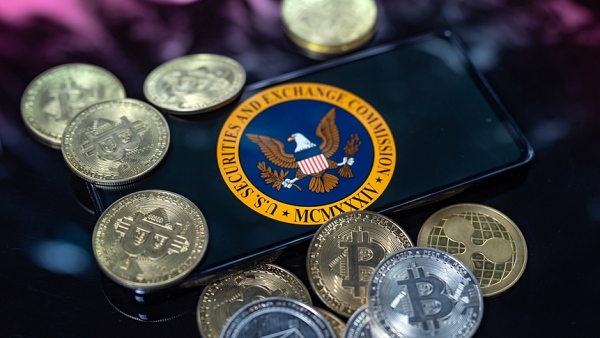
The U.S. Securities and Exchange Commission has sent a warning message to the DeFi industry, saying crypto vaults and on-chain lending products could fall under federal securities laws depending on their structure. It said that even if automated smart contracts are used, they could be subject to securities regulation if human discretion intervenes in actual operations.
On July 22, blockchain media outlet U.Today reported that SEC Commissioner Hester Peirce (헤스터 피어스) said in a recent statement that while many crypto assets and related activities are outside the SEC's jurisdiction, that does not mean all DeFi products avoid federal securities laws.
Peirce stressed that existing securities laws do not become inapplicable simply because investment activity is carried out on a blockchain network. "Moving activities that fall within the scope of federal securities laws on-chain does not remove them from the scope of the laws the commission enforces," she said.
The SEC is focusing on crypto vaults that have spread rapidly in the DeFi market. Vaults are services that generate returns by automatically executing various on-chain strategies such as staking, lending and providing liquidity after users deposit digital assets.
The SEC did not view all vaults the same way. That is because some vaults have hard-to-change smart contracts that handle asset management entirely, while others are structured so that an operating team or a specific individual decides asset allocation and investment strategy.
Peirce explained that these differences in operating methods could be central to regulatory determinations. If human discretion materially intervenes, it is necessary to examine whether the activity is subject to federal securities laws. That means what matters is not simply whether automation technology is used, but who has actual decision-making authority and operational responsibility.
The SEC said it could apply the same principle to on-chain lending protocols. In on-chain lending, users deposit cryptocurrencies into a protocol, which lends them to borrowers and generates interest income. Peirce said who sets key terms such as interest rates, supported assets, loan-to-value ratios (LTV), and liquidation standards could be an important factor in deciding whether securities laws apply.
She added that not all on-chain lending products have the same legal character. Depending on how a product is distributed, participants' investment purpose and the operating structure, some could be deemed securities under existing securities laws.
The remarks are interpreted as making clear that it is difficult to view vaults and on-chain lending, which are leading yield products in the DeFi industry, as being in a regulatory blind spot simply because they are blockchain-based.
The market believes key standards dividing regulatory risk will be how much each DeFi protocol has removed operational discretion and whether smart contracts automatically determine core elements such as interest rates and collateral terms or whether an operating organisation controls them.
 Jinju Hong
hongjj@d-today.co.kr
Jinju Hong
hongjj@d-today.co.kr