
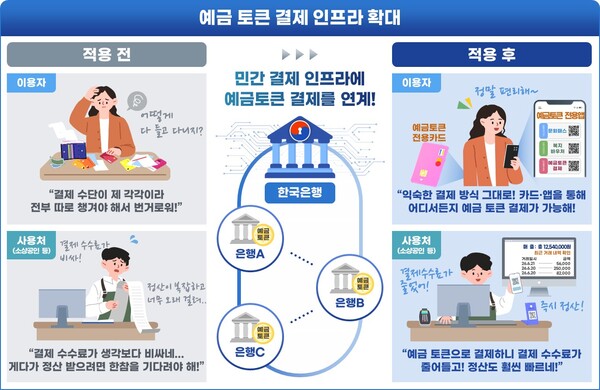
The Korea Internet & Security Agency (KISA) and the Ministry of Science and ICT said on Tuesday they held a joint launch ceremony at KISA's Seoul office with related agencies for the “Deposit Token-Based Payment Infrastructure Expansion Project,” selected for the 2026 Blockchain Innovation-Leading Project. They said they are moving ahead with the project in earnest.
According to KISA, the project will be 추진 through a cooperation framework with related agencies including the Ministry of Economy and Finance and the Bank of Korea to expand the use of deposit tokens and improve outcomes.
The Korea Financial Telecommunications and Clearings Institute will serve as the lead agency, with a consortium including 9 commercial banks, 8 payment service providers and 2 large demand-side firms.
The institute will link existing payment infrastructure with the Bank of Korea’s Project Hangang system to enable deposit token payments. It will also oversee service development and demonstrations by participating institutions. The total project budget is 9.6 billion won.
The project aims to spread deposit token demonstration experience based on the institutional central bank digital currency (CBDC) accumulated through the Bank of Korea’s Project Hangang into private-sector payment areas that the public can feel, and to generate tangible results such as easing burdens on small merchants. The institute plans to work with the Ministry of Economy and Finance to broaden use into public finance areas such as business promotion expenses and expand the project’s ripple effects.
The Ministry of Economy and Finance plans to apply deposit tokens to a pilot programme for business promotion expenses in connection with the project. It plans to consult with the Office of Planning and Budget and the Fiscal Information Service to develop a treasury fund management model linked with dBrain in order to expand into various areas of treasury fund execution in the future.
The Ministry of Science and ICT plans, through the project, to create public-facing use cases for blockchain technology. It also plans to expand opportunities for blockchain companies, including small and medium-sized enterprises and startups, to participate in development, operations and service rollout, strengthening the competitiveness of South Korea’s blockchain industry ecosystem.
Shin Dae-gyu (신대규), head of the Digital Infrastructure Division at KISA, said the project was a first step toward fully implementing a deposit token payment and settlement environment. He said it would provide an opportunity for various small and medium-sized IT firms and startups to create innovative services and new business models based on the infrastructure built through the project. Shin said KISA would support the implementation of safe and trustworthy services based on its expertise in blockchain and information security, and would actively support the results spreading nationwide.
 Hwang Chi-gyu
delight@d-today.co.kr
Hwang Chi-gyu
delight@d-today.co.kr