
An analysis has emerged that Ethereum (ETH) could become the next asset to benefit from the artificial intelligence (AI) investment cycle. It argues that early signals are appearing that AI investment money is shifting from semiconductor stocks, especially those tied to memory chips, to Ethereum. No direct fund-flow data has been presented to support this, raising calls for further verification because the interpretation is based on market performance.
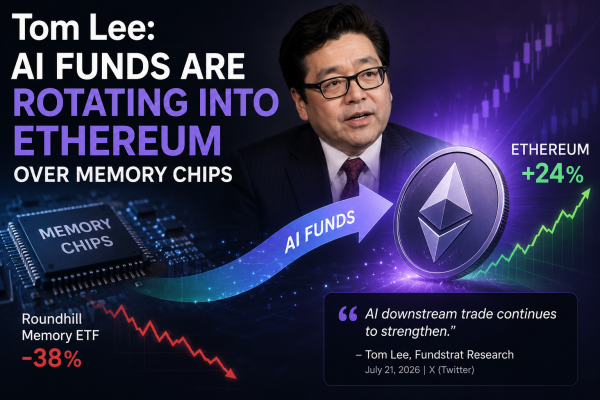
On July 22 local time, blockchain media outlet Cryptopolitan reported that Tom Lee (톰 리), head of research at Fundstrat Research, said on social media platform X, formerly Twitter, that "AI Downstream" trades continue to show strength. He argued that a trend is emerging in which AI investment money is moving from memory-chip makers to Ethereum.
He cited a return gap over the past month between Ethereum and a memory-chip-related exchange-traded fund (ETF). In figures he presented, Ethereum rose about 24 percent over the past month, while the Roundhill Memory ETF fell about 38 percent over the same period. The performance gap between the two assets amounts to 72 percentage points.
Fundstrat also released a comparison chart showing the two assets moving in opposite directions recently. Lee cited this to raise the possibility that AI investors' attention is shifting from hardware to digital infrastructure.
This analysis, however, does not prove an actual shift in institutional money. Fundstrat did not release fund-flow data showing that money leaving semiconductor stocks actually flowed into Ethereum-related products. For now, it is closer to interpreting a change in investor sentiment based on relative returns over the past month.
Lee has consistently offered an optimistic outlook on Ethereum. He has assessed that as AI services spread, demand will rise for decentralised payments, real-world assets (RWA) and on-chain financial infrastructure, and that the Ethereum network is likely to sit at the centre of that trend.
He continued the same logic in this analysis. He said the investment focus in the AI industry could expand from hardware such as chips and servers to blockchain infrastructure that supports actual services.
The choice of a memory-chip ETF as the comparison target is linked to that view. The Roundhill Memory ETF, launched in April 2026, is an ETF that concentrates on memory semiconductor companies such as high-bandwidth memory (HBM), DRAM and NAND flash. Memory chips are seen as essential components for training and inference of large AI models and are viewed as a key indicator of sentiment on AI infrastructure investment.
It is difficult, however, to say that growth prospects for the memory industry itself have weakened. Market research firm IDC forecasts that global AI-related spending will expand to $758.0 billion in 2029 and expects demand for AI storage and memory to rise steadily as companies increase AI adoption.
Market research firm TrendForce also predicted in a recent report that contract prices for general DRAM in the third quarter of 2026 will rise 13 to 18 percent and NAND flash prices will increase 10 to 15 percent. It said growing demand for AI servers will continue to push memory prices higher.
For that reason, some suggest the recent weakness in the memory ETF could be a short-term adjustment driven by profit-taking or a rebalancing of semiconductor weightings rather than deteriorating industry conditions. Lee also did not provide a specific explanation for why money left memory-related assets.
In the cryptocurrency market, some are taking the claim as a new investment rationale for viewing Ethereum. That is because a view could spread that Ethereum, previously assessed as a DeFi and smart-contract platform, could be re-rated as a digital infrastructure asset in the AI era.
Even so, many say it is too early to conclude that there is a structural shift in institutional money based only on a one-month performance gap. Key points for verifying the claim are whether inflows into Ethereum-related investment products continue even during periods when semiconductor stocks rebound, and whether actual institutional fund-flow data supports it.
 Jinju Hong
hongjj@d-today.co.kr
Jinju Hong
hongjj@d-today.co.kr