
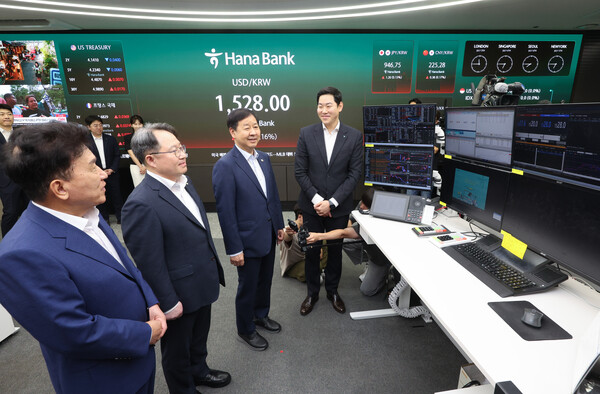
South Korea’s onshore won-dollar foreign exchange market enters a 24-hour trading regime from July 6. The shift allows the won’s price to adjust at night, rather than overseas news and U.S. economic indicators being reflected all at once the next morning, putting securities firms’ currency conversion services and foreign-currency risk management capabilities to the test.
Won-dollar trading in the Seoul foreign exchange market switches to a 24-hour system from 6 a.m. on Thursday.
The previous trading hours ran from 9 a.m. to 2 a.m. the next day. Going forward, the market will operate without interruption from 6 a.m. Monday to 6 a.m. Saturday, based on New York daylight saving time. When daylight saving time is not in effect, it will run from 7 a.m. Monday to 7 a.m. Saturday.
Won-dollar trading will also be available on South Korean public holidays, excluding weekends and Jan. 1. Holiday settlement will be processed based on banks’ business days. Trading hours for currencies other than the U.S. dollar remain 9 a.m. to 3:30 p.m.
The key to the overhaul is the speed of price reflection. In the past, if U.S. employment data, the Federal Open Market Committee (FOMC), the consumer price index (CPI) and geopolitical issues occurred after the Korean market closed, exchange rates often moved all at once on the next trading day morning.
Now that the won-dollar spot market is also open at night, exchange rates can reflect global events at the time they occur.
The government and the Bank of Korea expect improved access for foreign investors. If won funding and currency conversion become available during New York and London hours, it will improve convenience for foreigners investing in domestic stocks and bonds. The government views the move as an FX market structure reform task that strengthens the foundation for inclusion in the MSCI developed market index.
For securities firms, overseas stock services and management of foreign-currency deposits become direct challenges. Domestic investors generate demand for overnight currency conversion to match U.S. stock trading hours. With a 24-hour FX market, there is more scope to use exchange rates that reflect actual market moves rather than indicative rates.
Whether to offer actual 24-hour currency conversion services to retail customers is expected to vary by securities firm, depending on IT systems, exchange-rate postings, partner bank systems and foreign-currency limits.
If overnight currency conversion expands, securities firms will also face a heavier burden in managing foreign-currency positions. If customers’ conversion orders come in real time, firms will need to run their dollar trading books and limits more precisely.
Sharp exchange-rate swings can affect foreign-currency deposits, margin debt, collateral value and funds for settlement of overseas stock trades. Beyond improving customer convenience, firms will also need to review risk limits, dealing systems, responses to system disruptions and overnight staffing operations.
The asset management industry is also within the sphere of impact. For overseas equity and overseas bond funds and exchange-traded funds (ETFs), exchange-rate moves are reflected differently in returns depending on whether products are hedged or unhedged. If the won-dollar rate moves at night as well, the importance of overseas asset valuation, hedging costs and management of derivatives positions could increase.
The base exchange rate will not immediately fully switch to a 24-hour system. Through the end of this year, the current Market Average Rate (MAR) method will remain, calculated as a weighted average of exchange rates and volumes traded from 9 a.m. to 3:30 p.m.
From Jan. 1, 2027, it is set to change to a time-weighted average price (TWAP) method as of 4 p.m.
An initial variable is overnight liquidity. Even if the market is open 24 hours, if there are not enough participants during Korean night hours, the gap between bid and ask quotes can widen and exchange rates can swing sharply even on small orders. Gap moves the next morning could decrease, but there remains the possibility of higher overnight volatility immediately after the release of U.S. data.
The financial investment industry sees that for longer trading hours to lead to exchange-rate stability, participation by banks, securities firms, overseas financial institutions and companies needs to increase sufficiently at night as well. Opening the FX market is a change that improves access to the domestic capital market, but it leaves financial companies with the task of 24-hour risk management.
An industry official said, "If the FX market runs 24 hours, not only FX conversion services but also foreign-currency positions, FX hedging and systems responses must switch to an overnight framework." The official added, "In the early stages, internal risk management could be an important task as much as expanded customer convenience."
 Oh Sang-yup
yub@d-today.co.kr
Oh Sang-yup
yub@d-today.co.kr