
KT will make “tokens”, an emerging economic unit in the AI era, a key pillar of its future new business. Based on billing know-how built in its telecoms business, it will expand its revenue model with a “token factory” that optimises AI usage and supports fast settlement.
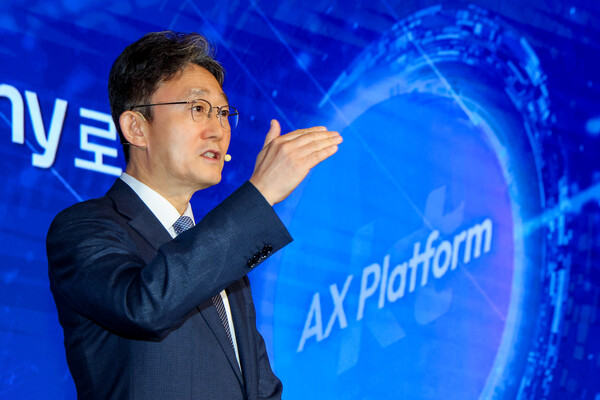
Park Yun-young (박윤영), CEO of KT, on July 6 presented the “AI transformation (AX) platform company” strategy at his first news conference since taking office. He also proposed the token factory as a new growth business.
A token factory is a business model that supplies tokens generated during the use of AI services more cheaply and efficiently. Tokens are the basic unit used when AI models process text, images and code, and a key standard for calculating model usage fees. Goldman Sachs Research forecasts that global token consumption will increase 24-fold from 2026 to 2030 amid the spread of agentic AI, reaching 120 quintillion tokens per month. KT’s plan is to manage token costs, which have become a key variable in corporate business expenses, and earn revenue from them.
KT is focusing in particular on “routing” and “billing”. It plans to build a token gateway that analyses the intent of customer requests and connects them to the optimal model. A token gateway is a solution that serves as a router at the front end of an AI service. KT’s token factory is expected to analyse customer requests and then send them along the most suitable route among options including its own model and external large language models (LLMs), considering cost, quality and latency.
KT will also combine 1 GW of AI data centres (AIDC) distributed nationwide with a token optimisation engine that includes its own model. Its goal is to build a platform that supports token generation, brokering and billing. The company says this can reduce unnecessary calls to expensive models and lower overall token usage and inference costs.
Park Sang-won (박상원), head of KT’s AX Business Division, said at the news conference, “The key is to produce and supply tokens in the cheapest and most efficient way.” He said, “We will optimise resources such as graphics processing units (GPUs) and neural processing units (NPUs) to lower token generation costs, and minimise token usage with context-based automatic routing technology.”
KT is the first among South Korea’s three telecoms carriers to present a token factory as a new business model. If commercialisation succeeds, KT can secure platform fees or usage-based revenue in the process of supporting token generation, brokering and billing. For the token factory to become a core new business, it must prove routing accuracy and cost-saving effects. Key issues also include what criteria it uses to connect its own model with external models and how it meets companies’ security requirements.
Park said, “We need to settle accurately who used how many tokens, and that is what telecoms operators do best.” He said, “We will create a new revenue model by combining billing capabilities built over decades of operating various bundled products and complex rate plans with AIDC, and we will also cooperate with foundation model companies.”
Separately, KT plans a total investment of 18 trillion won, including 12 trillion won over three years to strengthen core telecoms areas such as information security and networks and 6 trillion won for AX infrastructure including AIDC, to accelerate its push to become an AX company.
 Jin-ho Lee
jhlee26@d-today.co.kr
Jin-ho Lee
jhlee26@d-today.co.kr