
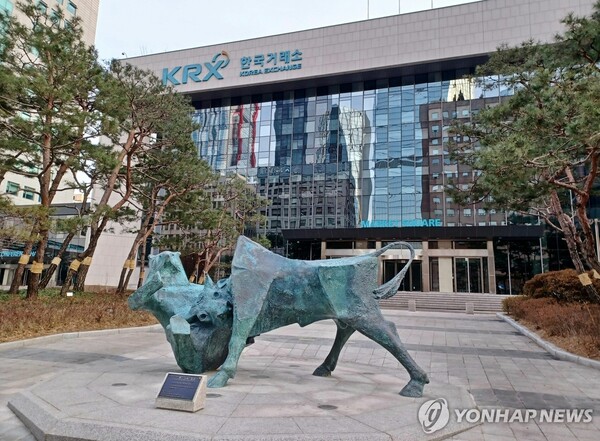
Financial authorities will in principle ban asymmetric duplicate listings that do not take into account the rights of ordinary shareholders in parent companies. To list a subsidiary, a parent company's board must prepare a shareholder impact assessment and shareholder protection measures, and in some cases go through a shareholder approval procedure.
The Financial Services Commission and the Korea Exchange said they began on July 7 a formal public consultation on proposed revisions to exchange rules to implement the principle ban on duplicate listings and a draft for new duplicate listing guidelines.
The detailed standards follow up on the "capital market structural improvement plan" announced in March. The FSC and the exchange set the standards after holding three public seminars and collecting feedback from stakeholders.
Authorities said domestic duplicate listings have at times been pushed as a matter of practice despite concerns about infringement of the rights of ordinary shareholders. They judged that parent company boards and controlling shareholders did not bear separate obligations to protect ordinary shareholders of the parent company, citing the reason that "a subsidiary listing is a matter for the subsidiary board to decide."
The FSC and the exchange will therefore impose five obligations on parent company boards based on their duty of loyalty to shareholders. The five obligations are a shareholder impact assessment, preparation of shareholder protection measures, confirmation of whether to communicate with shareholders or obtain shareholder approval, a board resolution for or against and notification to the subsidiary, and disclosure.
If a parent company's board does not hold a shareholder approval vote, it must also disclose the reason. When fulfilling the five obligations, it must also go through deliberation and resolution by an independent special committee.
The obligations apply equally when a subsidiary is listed on an overseas exchange rather than a domestic exchange.
New special screening standards for duplicate listings will also be introduced. The key is the subsidiary's operational and management independence and protection of parent company investors. If the subsidiary's main business excessively depends on the parent company or major decision-making is in effect carried out by the parent company, it will be difficult to meet the independence requirement.
For protection of parent company investors, the parent board's fulfillment of the five obligations and a resolution in favor are prerequisites. Screening will also examine whether shareholder protection efforts commensurate with the need to protect ordinary shareholders have been carried out.
As a way to assess whether shareholder protection efforts are sufficient, shareholder approval is in principle recommended. The shareholder approval standard follows the 3 percent rule by limiting voting rights above 3 percent and requiring consent from a majority of shares present and at least one quarter of total voting rights.
For subsidiaries created through a spin-off, shareholder approval is mandatory. For ordinary subsidiaries, obtaining shareholder approval is presumed to meet the shareholder protection effort requirement, while failure to obtain approval triggers strict case-by-case review by the exchange.
An exception applies to low-weight subsidiaries. If revenue, operating profit and assets are all below 10 percent of the parent company's, investor protection requirements are presumed to be met even without shareholder approval, if the parent board faithfully fulfills the five obligations and passes a resolution in favor.
Even so, if it is recognized as an important subsidiary in light of its expected corporate value, an exemption from shareholder approval will not apply.
The duplicate listing rules apply when a parent company is listed and lists an unlisted company it substantially controls or that is in effect an economic entity identical to it. Targets include subsidiaries under the External Audit Act and affiliates under the Fair Trade Act that are in a vertical control relationship.
A vertical control relationship is judged based on whether the parent company holds a 20 percent or higher stake in an affiliate, or whether the affiliate in turn holds more than 50 percent of its subsidiaries or sub-subsidiaries.
The FSC and the exchange plan to finalise and implement the revisions through resolutions at regular meetings of the Securities and Futures Commission and the FSC after a notice period through July 14.
Once the guidelines take effect, whether ordinary shareholders of parent companies are protected is expected to emerge as a key screening standard in the listing of subsidiaries of major conglomerate groups and in efforts to list after a spin-off.
In the IPO market, predictability in listing reviews could improve, but some companies' listing schedules could be delayed as the burden rises to obtain shareholder approval and prepare protection measures.
 Oh Sang-yup
yub@d-today.co.kr
Oh Sang-yup
yub@d-today.co.kr