
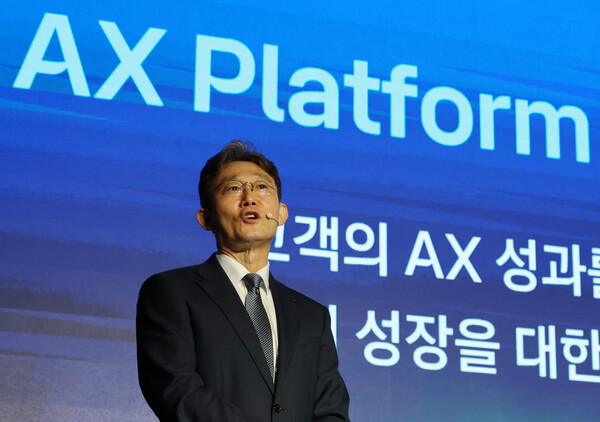
KT presented a new vision to move beyond its core capabilities as a key national telecommunications operator and become an "AI transition (AX) platform company." It plans to expand AI data centres (AIDC) and lead the future AI market through new businesses such as a token factory and stablecoins.
KT CEO Yoon-young Park (박윤영) shared the plan on July 6 at his first news conference since taking office, held at the Pullman Ambassador Seoul Eastpole hotel in Gwangjin-gu, Seoul. Explaining the concept of an AX company, Park said it is like an enabler that helps actors shine on stage and perform well. He said he will work with partners to develop it into a new-growth AX business model.
KT presented a corporate vision to help the public sector, industry and individuals grow through AX. It set a strategy to build a virtuous cycle in which fundamentals and growth reinforce each other, with “solid fundamentals” and “clear growth” as the two pillars.
◆ 12 trillion won over three years for information security, IT and networks
KT will invest a total of about 12 trillion won over three years in information security, IT and networks to strengthen its “solid fundamentals.” Last year, following an incident involving unauthorised small-amount payments, KT previously signalled it would strengthen security investment. It will invest 4 trillion won in information security and IT innovation, double the amount of the previous three-year period. It will invest 8 trillion won in networks. It will focus investment from the second half of this year and into next year.
KT will redefine its company-wide security system under the zero-trust principle of “trust nothing and always verify thoroughly.” It will pursue steps including building an always-on prevention and response system based on zero-trust security, ensuring information security and IT stability through a shift to cloud-native, integrating security operations governance split between IT and networks, and establishing a rapid and transparent crisis response system.
It will also separate the chief information security officer (CISO) and chief privacy officer (CPO) roles. KT will recruit external experts and double its information security staff. It will strengthen cooperation with outside specialists through steps such as forming an advisory committee spanning industry, academia and research, working with white-hat hackers, and identifying joint research and business opportunities. It will set up a security master’s programme with Seoul National University to bolster information security staffing. This year’s hiring of new employees will be expanded to 140, an increase from typical years, to strengthen recruitment of talent.
In networks, the focus is on improving customer-perceived quality and core competitiveness. KT will proactively diagnose and improve network quality and secure leadership in key future network technologies such as 6G, satellites and data centre interconnect (DCI). It will build an automated system to manage asset matching rates and assign personnel dedicated to updating asset records and inspecting vulnerable facilities.
In satellites, it will directly control and operate multiple geostationary orbit (GEO) and low Earth orbit (LEO) satellites to secure communications sovereignty. Based on more than 50 years of accumulated know-how in satellite control, operations and services, KT operates 5 GEO satellites. It also plans to expand into the LEO satellite business through global partnerships and lead the domestic satellite ecosystem.
◆ Additional 1GW of AI data centres; stronger undersea cable investment
On infrastructure, KT will invest about 5 trillion won to add AIDC capacity totalling 1GW based on actual demand. It aims to provide nationwide ultra-low-latency, real-time inference environments needed for physical AI and the autonomous driving era by linking central AIDCs that meet large-scale training and inference demand with AI edge capacity expanded near industrial sites.
KT will also expand investment in undersea cables. To meet rising demand for global undersea cable traffic linked to AIDCs, it will invest 1 trillion won and plans to add at least 90 Tbps of supply capacity. Based on the expanded infrastructure, it plans to attract domestic AIDC investment by global big tech companies and develop South Korea into an Asian AX connectivity hub.
In services, it will provide industry-specific B2B AX execution tools that address customers’ core needs in finance, public services, manufacturing and healthcare. In finance, based on its track record in financial digital transformation (DX), it will expand agentic AI such as AI contact centres (AICC) and sales agents by sector.
In the public sector, it will target government AX demand with trust-based AI services grounded in sovereign AI. In manufacturing and healthcare, it will expand its physical AI business by taking part in government demonstration projects, including the Ministry of Science and ICT’s robot foundation model demonstration.
In B2C, it will introduce hyper-personalised B2C AX that hands customers control over products and services. It will pursue customer-designed pricing plans and benefits, optimal tailored service proposals based on usage pattern analysis, and digitalisation of the entire journey from subscription to customer service. Park said the goal is to reduce inconveniences such as complex pricing plans, benefits limited to what telecom operators set, and cumbersome procedures from subscription through consultations.
◆ New business push with token factory and stablecoin
KT will also step up its new-growth AX businesses by moving forward with a token factory and stablecoin business. In particular, it expects the token factory to become a key new business for the AI era. As tokens draw attention as an economic unit in the AI era, KT aims to extend its billing and settlement capabilities, accumulated through telecom network operations, into AI businesses.
KT will build a token factory capable of supporting token creation, brokerage and billing by combining its distributed 1GW-scale AIDC network nationwide with a token optimisation engine that includes its own model. Park said no one does billing as well as telecom operators. He said KT will connect it to new business by adding billing capabilities to a token gateway approach.
It will also enter the stablecoin-based digital financial platform market. KT Group will combine Kbank’s base of 16 million customers, BC Card’s 3.5 million merchants and its payment and settlement capabilities, KT’s ultra-low-latency, high-reliability network and security infrastructure, and its partnership ecosystem. Based on capabilities across the full value chain from issuance to custody, settlement, network transmission and a real-use ecosystem, it will prepare business models that respond to institutional changes.
KT will also step up its push into global markets. Based on AX infrastructure businesses such as AIDC and AI models, it will gradually combine AX solutions including the token factory, stablecoins and physical AI to refine its business model. It has also set out a roadmap to expand its business footprint beyond ASEAN to include the Global South, including emerging markets.
It will diversify partnerships as well. KT will continue to seek mutually beneficial cooperation with Microsoft. Park said it remains unchanged that many of KT’s cloud resources operate stably on Microsoft Azure. He said cooperation has been proceeding well so far. KT will also broaden cooperation to global AI companies such as Google and Palantir, and domestic AI companies such as Upstage, Rebellions and Saltlux, to expand customer choice.
Meanwhile, the industry is seeing analysis that KT may re-merge KT Cloud to accelerate its shift into an AX company. KT has said it is reviewing cooperation options in various ways.
 Jin-ho Lee
jhlee26@d-today.co.kr
Jin-ho Lee
jhlee26@d-today.co.kr