
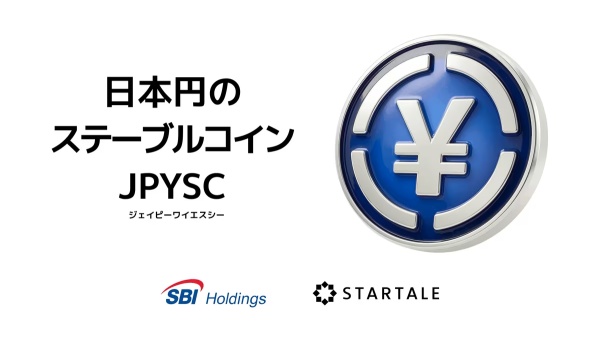
Japan's financial group SBI plans to issue its yen-pegged stablecoin JPYSC as early as this week.
On June 23, blockchain media outlet The Defiant reported that SBI has received approval from Japan's Financial Services Agency and will begin issuance procedures within days.
If JPYSC launches as scheduled, it will be the first yen stablecoin issued by a financial institution to apply a trust-bank structure under Japan's Payment Services Act framework. SBI said in February that JPYSC is a trust-based stablecoin issued by Shinsei Trust Bank under Japan's regulatory framework. Distribution will be handled by SBI VC Trade, and development was carried out jointly with Singapore-based Startale Group. SBI's deadline for a second-quarter 2026 launch is June 30.
The key to the issuance is its regulatory structure. JPYSC is classified as a Type 3 electronic payment instrument under Japan's revised Payment Services Act. The system took full effect in June 2023, and related enforcement rules took effect on June 13. Under the trust bank model, token holders have beneficial interests in the trust. Reserves are kept in segregated accounts at SBI Shinsei Trust Bank and, under the Trust Act, are separated from the finances of the issuer and the trust bank.
The structure also differs from existing yen stablecoins. JPYC launched Japan's first Payment Services Act-approved yen stablecoin in October 2025 under a Type 2 money transfer licence, but a 1 million yen cap applies to remittances and balances in Japan. SBI's trust-based classification has no such ceiling, opening a path for use in corporate fund settlement and large-scale institutional trading.
SBI sees JPYSC as infrastructure linking traditional finance and digital finance. Yoshitaka Kitao (기타오 요시타카), chairman of SBI, said in December last year that the project will dramatically accelerate the trend of providing digital financial services fully integrated with traditional finance. Startale Chief Executive Sota Watanabe (와타나베 소타) also cited AI agent payment networks and distribution of tokenised assets as key use cases for JPYSC.
The distribution infrastructure is already operating. SBI VC Trade completed Japan's first registration as an electronic payment instrument exchange business in March 2025, and listed Ripple's RLUSD in March this year. If JPYSC is issued, it can immediately use its in-house distribution channel. Startale raised $63 million in a Series A round that included $50 million from SBI and $13 million from Sony at the end of March, and the funds were allocated to the development of JPYSC and the dollar stablecoin USDSC.
It has not yet been disclosed which blockchain will be used to issue JPYSC. Startale is a co-developer of Sony's Ethereum layer-2 Soneium. In February, it also unveiled the institutional layer-1 Strium aimed at tokenised securities and stablecoin payments.
Moves by Japan's financial sector on stablecoins are not limited to SBI. MUFG, Mizuho and SMBC launched a joint stablecoin consultative body on June 10 and set a goal of starting interbank real transactions by March 31, 2027, based on the Progmat platform. They also use the same Type 3 trust-based electronic payment instrument classification as JPYSC, but chose a joint issuance structure by multiple banks rather than a single company.
Japan was the first among the Group of Seven in 2022 to establish a comprehensive stablecoin legal framework. With enforcement rules also completed on June 13, the final regulatory requirement needed for issuing new electronic payment instruments has been resolved. As a result, JPYSC is expected to be one of the first cases to gauge the pace of real commercialisation in Japan's regulated stablecoin market.
 Yoonseo Lee
yslee@d-today.co.kr
Yoonseo Lee
yslee@d-today.co.kr