
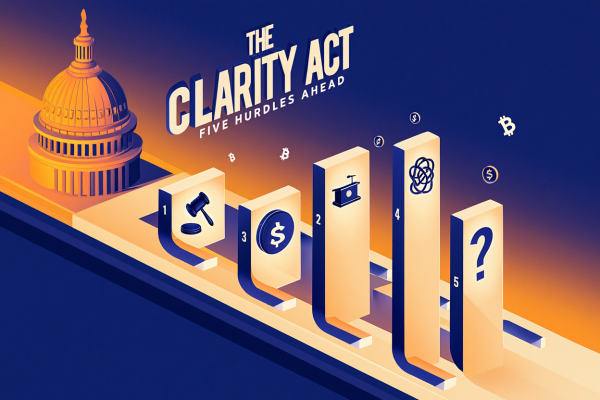
The U.S. Consumer Technology Association (CTA), whose members include Amazon, Apple and Google, urged the U.S. Senate to swiftly process the Clarity Act, a digital asset market structure bill.
On June 22, The Defiant, a blockchain media outlet, reported that Senator Cynthia Lummis (신시아 루미스) also offered public support the same day, saying the situation should end in which developers must rely on groups of lawyers to determine whether their code is legal.
In a letter sent on June 17 to Senate Majority Leader John Thune and Senate Democratic Leader Chuck Schumer, the CTA strongly backed the Clarity bill and demanded it be brought to the Senate floor without delay and passed. The group is a major U.S. consumer electronics industry association that hosts CES, and its members include Amazon, Apple, Google, Panasonic, Sony and Verizon.
The move is drawing attention because large technology companies outside the crypto industry have also begun to view regulatory uncertainty as a business issue. The CTA said the current uncertainty is making product launches, compliance planning and long-term investment decisions more difficult, and is also burdening non-crypto companies that provide services on blockchain infrastructure or link to it.
In a statement on June 22, Lummis put developer protections at the forefront. "Software developers should not need lawyers just because they want to know whether their code is legal," she said. "The Clarity Act can end that absurdity," she added. Lummis has continued to stress the same logic since the Senate Banking Committee approved the bill 15-9 on May 14.
The core of the bill is to split supervisory authority over digital assets between the Securities and Exchange Commission (SEC) and the Commodity Futures Trading Commission (CFTC), and to write into law the standards for when a token shifts from an investment contract to a digital commodity. It also includes safeguards so open-source software developers and self-custody technology providers are not treated as financial intermediaries solely because of other users' activity. It also includes a provision confirming the "right to hold one's own coins," which the non-custodial wallet industry has sought since 2022.
This is the part that the technology industry and Lummis are focusing on together. Supporters of the bill believe that the current enforcement stance, in which the SEC targets protocol developers or non-custodial wallet developers on the grounds that they were used for unregistered token trading, would be difficult to maintain if standards for classifying developers are set out in law.
Pressure on the Senate has increased rapidly over the past three weeks. On June 8, a coalition of more than 200 crypto companies led by Coinbase and Ripple urged Senate leadership to process the bill. In early June, 61 crypto industry executives and 160 retired national security officials also sent separate letters. With the CTA joining in, the number of stakeholder letter streams delivered to Senate leadership rose to four.
Still, the outlook for passing the bill remains fluid. Republicans hold 53 Senate seats, so even assuming unanimous support, additional Democratic votes are needed to pass the bill. Senators Mark Warner, Kirsten Gillibrand, Cory Booker, Chris Coons and Raphael Warnock are cited as key persuasion targets, but wording related to ethics rules and stablecoin profits has yet to be adjusted.
Lummis has warned that if the current window is missed, discussion of comprehensive crypto market structure legislation could be pushed back until 2030. She said that without clear legal standards, customers' claims to recover assets at digital asset exchanges may not be guaranteed in bankruptcy situations. By contrast, Senator Elizabeth Warren, a leading opponent of the bill, submitted 44 amendments during the committee review process, but all were rejected.
Tax legislation is also being pursued in parallel. On June 21, the Crypto Innovation Council asked the House Ways and Means Committee to pass as introduced H.R. 9175, a bill sponsored by Representative Mike Carey that would clarify taxation of mining and staking. The bill would defer tax recognition until disposal, instead of taxing at the time mining and staking rewards arise under the IRS's 2023-14 interpretation.
Ultimately, the issue is expanding beyond the crypto industry's demands into a business environment matter for mainstream technology companies. The next point to watch is whether the Senate sets a floor schedule before the August recess or pushes it to the fall session.
 Yoonseo Lee
yslee@d-today.co.kr
Yoonseo Lee
yslee@d-today.co.kr