
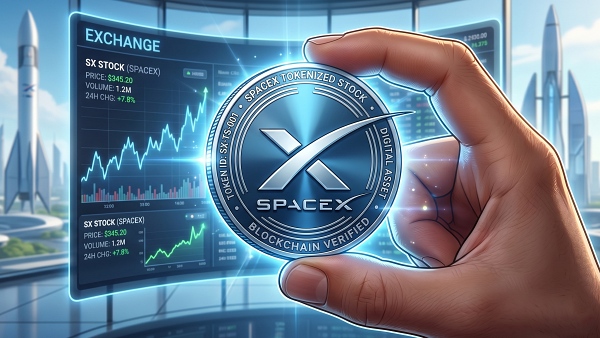
[DigitalToday reporter Jinju Hong (홍진주)] SpaceX’s initial public offering (IPO) has laid bare structural differences in the tokenised stock market. Even products marketed as SpaceX investments differ widely in actual share ownership, redemption rights, collateral structure and investor rights.
CryptoSlate, a blockchain media outlet, reported on June 13 that the SpaceX listing has spurred a wave of products including tokenised stocks, stock price-linked products and perpetual futures, heightening interest in investor protection and rights structures.
SpaceX on June 11 set an offering price of $135 per share and raised about $75 billion. It is seen as one of the largest IPOs on record. The shares began trading on Nasdaq on June 13 at $150 and climbed as high as $164 intraday.
The listing has given investors multiple ways to access SpaceX’s value beyond buying shares through traditional brokerage accounts, including blockchain-based tokens, exchange-tracked products, subscription-type tokens and stock price-linked perpetual futures.
But investor rights varied sharply by product. The most traditional format is the Nasdaq-listed stock. Investors own the shares and have shareholder rights.
By contrast, Backpack’s Solana-based SPCX token is structured so that Backpack buys and custodies actual SpaceX shares and issues the token with one-for-one collateral. Eligible investors can redeem the token for actual shares. Armani Ferrante, Backpack’s chief executive officer, explained that the goal is to make the underlying security transferable across different financial systems.
Products based on xStocks offered by Kraken and Bybit have a legally different structure. They are closer to tracking certificates that follow SpaceX’s share price. Investors can be exposed to price moves but do not own the shares. They therefore have no voting rights, shareholder rights or legal claim to the underlying shares.
Kraken stated in related guidance that "xStocks do not provide shareholder rights, voting rights, or legal claims to shares of the underlying company". Bybit also said the collateral assets are not always composed solely of SpaceX shares and can be replaced with cash or other assets.
Differences also emerged in the subscription process. Binance Wallet’s SPCXx subscription campaign drew about $557 million from about 28,000 wallets. Bybit also offered a similar subscription service through its IPO Express program.
But the volume requested by investors far exceeded the number of shares actually secured, causing a supply shortage.
According to Kraken’s growth team, the amount of SpaceX IPO allocation secured by the xStocks provider was smaller than expected, and demand from major platforms including Kraken, Bybit, Binance and Bitget far exceeded it. As a result, all allocated investors were reported to have received the same amount, about 4.2786 shares each.
The perpetual futures market showed another picture. Hyperliquid’s SPCX contract is a cash-settled derivative that is not linked to actual shares. It tracks SpaceX’s share price, but investors cannot own or redeem shares. Since its launch in May, it logged about $33 million in trading volume in the first 24 hours and at one point traded at prices above $220. That reflected a valuation of more than $2.5 trillion even before SpaceX set its offering price.
After the listing, the SPCX perpetual futures price traded around $176, staying above the actual Nasdaq trading range of $150 to $168. The industry assessed the gap as showing how far a derivative’s price can diverge from the value of the real asset when there is no redemption mechanism to exchange for physical shares.
The case shows that as the tokenised stock market grows rapidly, a clear understanding of product structures and investor rights is important.
Actual SpaceX shares or tokens issued with those shares as collateral provide indirect economic exposure to corporate treasury assets such as bitcoin held by the company. By contrast, tracking certificates or perpetual futures merely follow price moves and do not grant rights to the company itself.
Market size is expanding rapidly. CryptoSlate reported that related perpetual futures trading conducted ahead of SpaceX’s listing recorded about $3.2 billion in trading volume. It also said the tokenised stock market was worth about $1.68 billion, based on RWA.xyz data, up 39 percent over the past 30 days.
The industry expects that if large private companies such as OpenAI, Anthropic, xAI, Stripe and Databricks pursue listings, similar tokenised investment products will increase further.
The SpaceX case is seen as a representative example showing that even when the same name and ticker are used, the rights investors actually hold can differ widely. Critics say investors should first check not only the price but also whether the product is backed by actual shares, provides shareholder rights and allows redemption.
 Jinju Hong
hongjj@d-today.co.kr
Jinju Hong
hongjj@d-today.co.kr