
SynFutures has thrown its hat into the increasingly heated market for blockchain-based derivatives exchanges, flying the flag of decentralisation. With centralised exchanges and existing decentralised derivatives exchanges such as Hyperliquid already in place, attention is on whether it can expand its foothold.
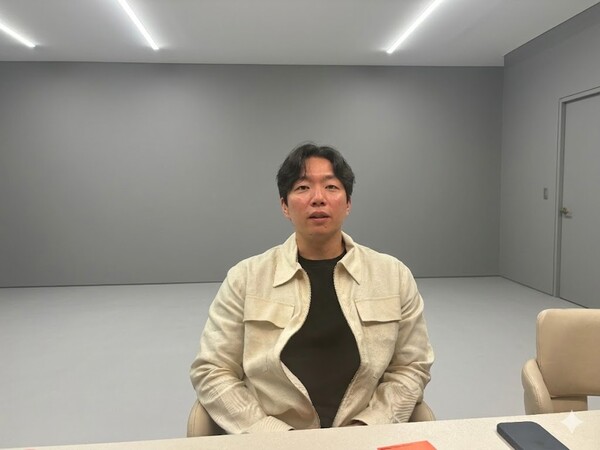
SynFutures co-founder Mark Lee (마크 리) said, "SynFutures provides the most open and decentralised platform." He said those characteristics would be a point of differentiation in the market.
He said SynFutures, unlike centralised exchanges, lets anyone list and trade tokens. It is structured so that users can decide what assets to trade, and when and how to trade them.
Lee said, "The biggest advantage is that it is permissionless DeFi. Real-world assets (RWA) and IP such as K-pop will also be listed in the future. Collectibles and intellectual property rights will be tokenised, and DeFi will lead this trend."
Several players, including Hyperliquid, have already entered the decentralised derivatives market. Large centralised exchanges such as Binance, Coinbase and Kraken are also expanding their territory into derivatives trading.
Lee said, "Hyperliquid is doing well as a case that made DeFi mainstream." He added, "SynFutures is focused on providing an experience like a centralised exchange based on a permissionless structure that does not require approval." He explained that using Ethereum layer 2 and then building its own mainnet and moving the platform are also part of optimising user experience.
Permissionless access and decentralisation are appealing concepts, but without safeguards they can also give malicious actors room to expand. That can be especially true for a trading platform. On that, Lee stressed that even as a decentralised platform, SynFutures also has minimum safety measures.
He said, "We will not let listings happen arbitrarily. As part of that, we require starting with at least $10,000 in liquidity. Instead, users can receive fees if trading goes well. We also use oracles through reliable partners and apply fees within a reasonable range."
SynFutures operates with a hybrid structure combining an order book and an automated market maker (AMM). Lee said, "It is hard for AMMs to scale. An order book can be used where liquidity is large, but that requires market makers. For tokens such as new tokens that do not have large liquidity and lack demand, market making is not easy. AMMs are advantageous for relatively new pairs."
Lee said SynFutures would provide an experience on par with centralised exchanges in terms of UX, but doing so in practice is not an easy task for a decentralised service.
He said, "We need to separate UX (User Experience) and UI (User Interface). Of course, decentralised platforms have shortcomings compared with centralised exchanges. Trading costs are high and sometimes speeds drop." He added, "We expect these issues to be largely addressed through a purpose-built mainnet. One-click transactions are not easy on-chain, but they are possible on our own blockchain. UX will improve through our own mainnet."
He said he would address UI through abstraction. "Users do not need to care about blockchain. They can sign up with email without creating a wallet. Through abstraction, trading on DeFi will become easier and easier," he said.
Raising efficiency through a mainnet could weaken the decentralisation that SynFutures highlights as a differentiator. Lee said, "As we improve UI, there are also parts that become centralised." He added, "Even so, token governance is a structure decided by users. Token holders implement governance through voting. The direction SynFutures pursues is decentralisation. From the user perspective, decentralisation that cannot be given up is protecting one's assets. It is self-custody. In DeFi, based on smart contracts, an exchange cannot touch users' money. The next important thing is trust. Users must be able to monitor well."
The SynFutures mainnet is focused on increasing trading speed. Lee expects the blockchain landscape to become one where various layer 1 blockchains, each optimised for different goals, coexist. He said he initially thought a small number of layer 1s would dominate, but his view has changed.
Lee said, "Layer 1s that fit their purposes will each grow. From the user's perspective, there is nothing bad about it. If UI and UX improve and it becomes possible to connect layer 1s flexibly, users will not even know that a trade was executed across multiple chains."
SynFutures plans to grow its mainnet into an ecosystem rather than using it only for itself. It aims to help entities that want to open decentralised, perpetual futures exchanges build services more efficiently in time and cost through the SynFutures mainnet. Lee said, "Through the SynFutures API, you can easily build and operate a decentralised perpetual futures trading platform. We will create many partners related to this."
SynFutures is targeting developing countries rather than advanced economies with established infrastructure. Lee said, "We are prioritising regions and countries with low market access. In these regions, it is not easy to buy stocks or even crypto assets. Initially, we will focus on targeting these countries." SynFutures cannot currently be used by U.S. users. Lee said he expected opportunities could open in the United States because the U.S. Commodity Futures Trading Commission (CFTC) is taking a forward-looking approach to DeFi.
 Chi-gyu Hwang
delight@d-today.co.kr
Chi-gyu Hwang
delight@d-today.co.kr