
[DigitalToday reporter Jinju Hong (홍진주)] Tether, the world’s largest stablecoin issuer, has filed a large number of trademark applications in South Korea, including its company name and logo, in preparation for entering the local market. As discussions in South Korea intensify on overhauling stablecoin rules, global issuers are also moving faster to secure an early foothold in the country.
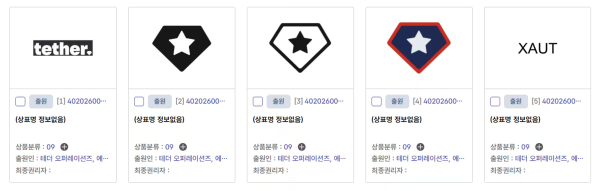
On May 19 (local time), blockchain media outlet Cryptopolitan reported that Tether recently filed a total of 7 trademark applications in South Korea. The filings include Tether’s corporate brand and its gold-linked stablecoin Tether Gold (XAUT).
In the industry, some interpret the trademark filings as more than simple brand protection and a step taken with entry into the South Korean market in mind. That is because South Korea is discussing a Digital Asset Basic Act that would require a foreign stablecoin issuer to have a local branch in order to distribute tokens.
Tether has previously registered trademarks in South Korea centered on some stablecoin product names, but this time it expanded the scope to include its corporate brand itself. The market views this as a move to secure a business base before the regulatory framework is put in place.
Rival Circle is also speeding up its push into the South Korean market. Jeremy Allaire (제레미 알레어), Circle’s chief executive officer, visited Seoul in April and discussed cooperation on stablecoin payments and real-world assets (RWA) with officials from KB Financial Group, Shinhan Financial Group and Hana Financial Group. Allaire also said at the time that if a regulatory framework is put in place that allows entry by foreign issuers, Circle plans to establish a South Korean subsidiary and obtain licenses and approvals.
Circle is also expanding cooperation with domestic trading platforms. It is pushing to expand adoption of USDC through Upbit, operated by Dunamu, and Bithumb. Hana Card, an affiliate of Hana Financial Group, also began a pilot project in March with Circle and Crypto.com that allows foreign visitors to South Korea to pay at domestic merchants with USDC.
South Korean card companies are also experimenting with stablecoin payment infrastructure. BC Card and KB Kookmin Card are also known to be testing related payment systems.
Tether is also continuing to expand distribution channels outside South Korea. It recently announced an investment and partnership with remittance platform Remitly and is pushing a plan to use USDT as a settlement means within its payment network. The plan is to replace existing SWIFT-based overseas remittances with blockchain-based real-time settlement. Paolo Ardoino (파올로 아르도이노), Tether’s CEO, explained that the goal of the cooperation is to expand financial access for about 585 million users.
The market also points to Tether’s stable earnings structure as a backdrop to expanding in South Korea. Tether posted net profit of $1.04 billion in the first quarter and excess reserves of $8.23 billion. The industry sees this as funds that can be used for investment in new markets and expanded partnerships.
South Korea is viewed as a major market with about 18 million cryptocurrency investors. Trading volume at domestic exchanges exceeded $663 billion last year, and active altcoin trading led by retail investors is also cited as a reason global issuers are focusing on South Korea as a strategic market.
Still, the domestic regulatory environment has not been finalized. The government and politicians continue to discuss whether to limit stablecoin issuance to commercial banks or introduce a more open licensing and approval system. Discussions on the related bill are expected to resume after the local elections in June.
At the same time, won-based stablecoin projects are also emerging one after another in South Korea, and the Bank of Korea is also conducting a second-phase real-transaction experiment for ‘Project Hangang,’ a wholesale central bank digital currency (CBDC) initiative.
In the industry, South Korea’s stablecoin market is seen as being rapidly reshaped ahead of rulemaking into a structure in which foreign issuers, financial companies, exchanges and won-pegged projects compete at the same time. Tether’s trademark filings are also interpreted as a signal that it has formalized its intent to enter the South Korean market amid that trend.
 Jinju Hong
hongjj@d-today.co.kr
Jinju Hong
hongjj@d-today.co.kr