
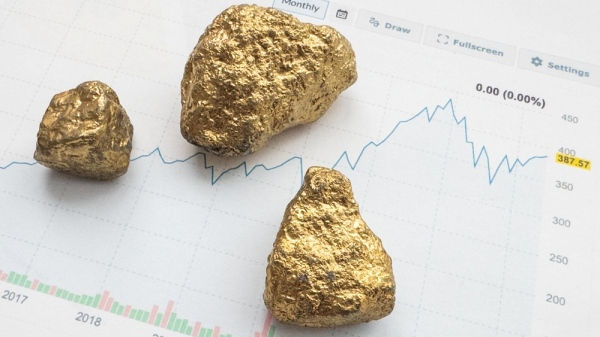
[DigitalToday reporter Jinju Hong (홍진주)] Major Wall Street banks are repeatedly raising their 2026 gold price targets, and Russian retail investors are rapidly increasing gold purchases.
On May 15 (local time), blockchain outlet BeInCrypto reported that JPMorgan expected gold to reach $6,300 an ounce by the end of this year. Deutsche Bank put the price at $6,000, Goldman Sachs at $5,400 and UBS at $5,900.
At the time of these forecasts, gold is trading around $4,548 an ounce. That is about 16 percent below the record high set in January. Many analysts see the pullback as a buying zone within a structural uptrend.
Russian retail investors have already started buying. According to the Moscow Exchange, gold trading volume in March 2026 was 42.6 tonnes, more than 3.5 times higher than a year earlier. Turnover was tallied at 534.4 billion roubles, a fivefold jump.
Russian investors also have more ways to access gold. These include OMS, banks' unallocated metal accounts, intermediary products such as GLDRUB_TOM that allow physical settlement the next day, gold exchange-traded funds, gold mining stocks and gold-linked digital financial assets.
Among them, there is an assessment that spot-like products are preferred. Oleg Reshetnikov of BCS World of Investment said: "The most convenient way for Russian investors to invest in gold and silver is 'gold in roubles' and 'silver in roubles' products with next-day settlement." The company set a gold price target of $5,385 over the next 12 months.
Demand for small investments is also rising. Alexander Ryabinin, a portfolio manager at SF Education, said: "The easiest way right now is to buy gold through a broker." He added: "Tinkoff Gold can be bought for 13 roubles in a broker app."
Still, there is also a view that a wider range of investment vehicles does not mean focusing on only one channel. Raiz Ismagilov of AVI Capital said: "Rather than praising only one channel, digital forms should be used to secure liquidity, some through an exchange and, if necessary, small holdings of physical metal should be mixed in like insurance."
Market variables also remain. U.S. inflation in April was 3.8 percent, the highest level in a year. That pushed back expectations for interest rate cuts by the Federal Reserve. India is cooling physical demand by raising the gold import duty to 15 percent.
Domestic supply and demand in Russia is also not uniformly supportive of higher gold prices. The Russian central bank has been a net seller of 22 tonnes in 2026 to fill a fiscal gap.
Even so, the current flow is weighted toward expanding retail demand. As Wall Street's upward revisions to gold price forecasts continue, Russian investors are using the pullback as a buying opportunity. Watching points include whether retail inflows continue, the path of U.S. prices and interest rates, and how much of a burden the Russian central bank's selling trend becomes.
 Jinju Hong
hongjj@d-today.co.kr
Jinju Hong
hongjj@d-today.co.kr