
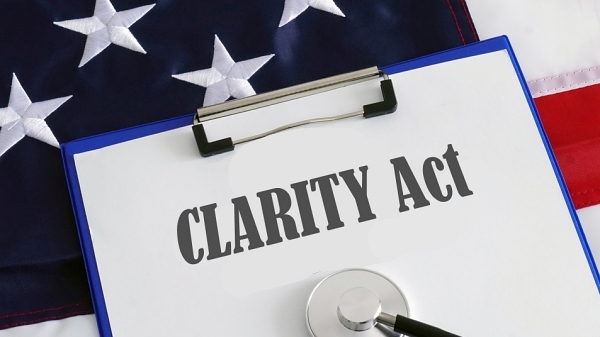
[Digital Today reporter Yoonseo Lee] The U.S. Senate's CLARITY Act has passed a Senate committee, but an ethics provision to prevent conflicts of interest among public officials has emerged as the biggest issue ahead of a floor vote.
Coinpost, a blockchain media outlet, reported on May 16 (local time) that a compromise has been found on previously contentious stablecoin interest rules, but the issue of private gains in politically connected cryptocurrency businesses has yet to be resolved.
The bill was approved by the U.S. Senate Banking Committee on May 15. The key variable for the bill’s passage is now not the rules on providing returns, but how far it will limit public officials and their families from gaining personal benefits from crypto ventures. Senator Ruben Gallego said he would vote against it on the Senate floor unless it includes strong language to prevent public officials and their families from pursuing private interests.
The direction of the debate has also shifted. The stablecoin interest issue, which the banking sector strongly opposed, was compromised around a ban on “passive rewards.” Ethics rules, by contrast, have emerged as an even bigger political issue. Concerns surrounding a project discussed as involving the family of U.S. President Donald Trump are amplifying Democrats’ objections.
Pressure remains from both markets and the congressional calendar. Investment bank TD Cowen raised its estimate of the bill’s chances of passage slightly to 40 percent, but 60 votes are needed in the Senate to overcome a filibuster. For now, it would be difficult to clear the threshold without additional Democratic cooperation. Sosovalue said securing 60 votes, including the support of at least 7 Democratic senators, is an absolute condition for a Senate floor vote.
The legislative deadline is also tight. The House is set to begin recess on July 27 and the Senate on Aug. 10, so work to merge House and Senate versions into a single bill must be completed before then. Sosovalue called the remaining review period before the summer recess a “golden time.” With both a floor vote and the unification process needing to proceed at the same time, delayed negotiations could lead directly to delayed processing.
Differences in intensity across specific issues are also clear. Issues related to jurisdiction between the U.S. Securities and Exchange Commission and the Commodity Futures Trading Commission, as well as anti-money laundering matters, are being settled to some extent. Ethics rules and the scope of responsibility for DeFi developers remain unresolved issues carrying heavy political burdens. In particular, there is concern that confrontation over the ethics provision could delay work to combine it with another bill that has passed the Senate Agriculture Committee.
The White House is aiming for enactment by July 4, and President Trump has indicated he is willing to sign it. But there are forecasts that meeting that deadline would be difficult if Republicans continue to reject Democrats’ ethics-related amendments. For now, securing 60 votes in the Senate, crafting ethics provisions Democrats can accept, and maintaining the existing agreement on stablecoin interest limits are cited as the three conditions for passage.
In the end, U.S. efforts to institutionalise cryptocurrency have moved from commercial compromise to a stage of political agreement. Rules on returns have been patched up, but ethics provisions have emerged as a new bottleneck. The pace of processing and the prospects for final passage of the CLARITY Act now depend on producing amendments that can sway Democratic votes.
 Yoonseo Lee
yslee@d-today.co.kr
Yoonseo Lee
yslee@d-today.co.kr