
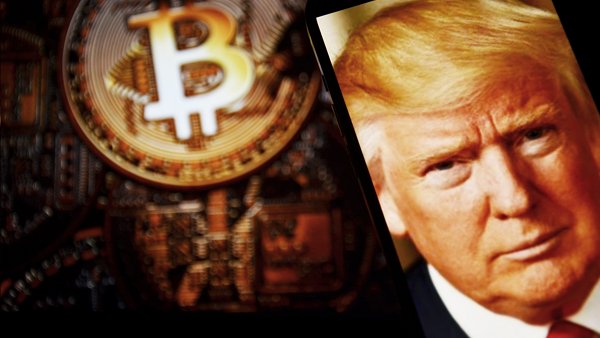
U.S. President Donald Trump’s family increased the share of indirect investments in crypto-linked listed stocks such as Coinbase and Strategy in the first quarter of this year. With controversy continuing over conflicts of interest between crypto policy and business, confirmation of the expanded investments is expected to intensify political sparring again.
On May 17 local time, blockchain outlet Cryptopolitan reported that the financial disclosure document "OGE Form 278-T" filed with the U.S. Office of Government Ethics included records of multiple trades in crypto-linked stocks in assets held in the names of President Trump, Melania Trump and dependent children.
The disclosure includes thousands of transactions carried out this year, and investigating authorities judged that Trump’s children effectively control the family assets. Key trades were concentrated in Coinbase, the largest U.S. cryptocurrency exchange, bitcoin miner MARA Holdings and Strategy, a company known for holding large amounts of bitcoin.
Coinbase shares were bought a total of 9 times during the first quarter. The largest single transaction took place on Feb. 10, and was recorded in the $100,001 to $250,000 range. Additional smaller purchases continued during the quarter.
Bitcoin miner MARA Holdings was also included among the investments. Each transaction was relatively small at $15,001 to $50,000, and the details were included in a 113-page disclosure document dated March 20. MARA posted a net loss of $1.26 billion in the first quarter. Some analysts assessed that the company is showing moves to shift its business focus to artificial intelligence and data center infrastructure.
Strategy shares were bought and sold at the same time. According to the disclosure, there were 8 transactions involving Strategy Class A common stock. The largest purchase occurred on Feb. 12 and was in the $50,001 to $100,000 range. The largest sale took place on Jan. 12 and was in the $15,001 to $50,000 range.
Strategy is the company with the largest bitcoin holdings among listed companies worldwide. More than 818,000 BTC is known to be recorded on the company’s balance sheet.
In politics, controversy continues over the possibility of a conflict of interest between President Trump’s personal crypto businesses and policy. In particular, during discussions over the "CLARITY" bill being pushed to establish a regulatory framework for digital assets, whether to restrict the president’s personal crypto businesses emerged as a key issue. Still, related ethical standards have not yet reached a clear agreement. Even so, the U.S. Senate Banking Committee passed the CLARITY bill on May 14 by 15 votes to 9.
The Trump Organization said the disclosed trades do not mean the president or his family directly selected the stocks. A company spokesperson said, "President Trump’s investments are managed through accounts in which an independent financial institution has full discretion," and added, "President Trump, his family and the Trump Organization are not involved in selecting or approving specific investment targets."
Markets also show signs of focusing on long-term business expansion potential rather than short-term performance of the related stocks. Investment bank Cantor Fitzgerald assessed the prediction-market businesses of Coinbase and Robinhood as a new growth driver.
One analyst said, "Investors are now paying more attention to future demand trends and product roadmaps than to quarterly results," and added, "New services such as prediction markets are emerging as a key variable."
The crypto market environment itself was weak in the first quarter. Bitcoin and ethereum prices fell about 23 percent and 29 percent, respectively, and trading activity slowed. Coinbase trading volume fell to about $54 billion in March from about $66 billion in January.
Cantor Fitzgerald presented a Coinbase trading-volume forecast below Wall Street expectations, but analyst Ramsey El-Assal maintained an "overweight" view on positive market sentiment and long-term growth potential and raised his target price to $250.
Markets also interpret the expanded investments as a signal in which crypto policy, political issues and market expectations are intertwined, beyond a simple portfolio adjustment.
 Jinju Hong
hongjj@d-today.co.kr
Jinju Hong
hongjj@d-today.co.kr