
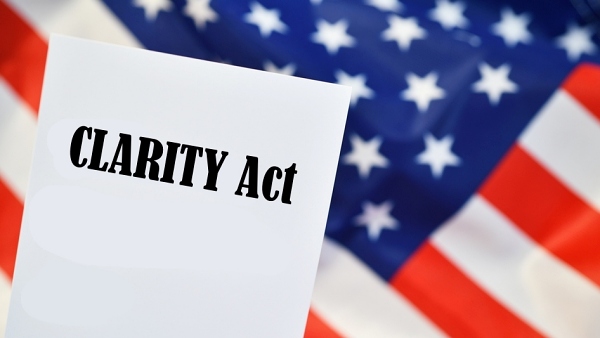
The U.S. Senate Banking Committee approved the crypto market structure bill known as the CLARITY Act by 15 to 9. Some Democratic senators attached conditions to support in the full chamber, and banks are also calling for tighter stablecoin rules, raising the prospect of further friction before final passage.
CoinPost, a blockchain media outlet, reported on May 15 that the committee passed the CLARITY Act by 15 votes to 9. Democratic senators Ruben Gallego (루벤 가예고) and Angela Alsobrooks (앤절라 올스브룩스) voted in favor alongside Republicans.
But whether the bill will pass in the full chamber remains uncertain. Both lawmakers attached conditions to their support in the full Senate. Gallego said after the vote that he would vote against it on the floor if language to prevent conflicts of interest related to the ethics provision is not resolved.
Debate over the ethics provision is also continuing. An amendment introduced by Chris Van Hollen (크리스 밴 홀런) failed by 13 to 11. The amendment would bar the president, vice president and members of Congress from holding cryptocurrencies and from pursuing related business. As a result, conflicts-of-interest issues involving elected officials and cryptocurrencies will move to negotiations ahead of the floor vote.
Rules on stablecoin yield rewards are also a major issue. The American Bankers Association (ABA), the Bank Policy Institute, the Consumer Bankers Association, the Financial Services Forum, the Independent Community Bankers Association and the National Bankers Association issued a joint statement calling for stablecoin provisions in the CLARITY Act to be revised before a full-chamber vote.
The dispute centers on Section 404 of the bill. It bans interest-like compensation for holding stablecoins but makes exceptions for activity-linked and transaction-linked rewards. Banks see the exception as a potential regulatory loophole.
The banking industry argued that the structure could create a channel for funds to move from bank deposits to stablecoins. The joint statement said that without an appropriate regulatory framework, stablecoins could take bank deposits and threaten local lending and economic activity.
The backlash from banks began even before the vote. Rob Nichols (롭 니컬스), ABA president and chief executive, sent an urgent letter on May 10 to financial industry CEOs asking them to lobby senators before the committee vote. The ABA estimated that if yield-bearing stablecoins spread, as much as $6.6 trillion could leave bank deposits and lending to consumers, small businesses and agriculture could fall by more than 20 percent.
During the committee process, lawmakers incorporated a compromise led by Thom Tillis (톰 틸리스) and Alsobrooks. It bans passive yield on stablecoin balances but allows limited activity-linked rewards. Democrats demanded a vote on an amendment to further tighten yield limits, but committee chairman Tim Scott (팀 스콧) did not accept it.
A provision for the Blockchain Regulatory Certainty Act (BRCA), which protects non-custodial software developers, remained unchanged. On decentralized finance regulation, Mark Warner (마크 워너) withdrew his amendment and said discussions would continue ahead of the floor vote.
The crypto industry generally assessed the legislative progress positively. The executive director of Stand With Crypto, a pro-cryptocurrency political group founded by Coinbase, said the full Senate vote would be lawmakers' most important vote on cryptocurrency.
The bill will go to a floor vote after a process to unify it with another version that passed the Senate Agriculture Committee. Passage in the full chamber requires at least 60 votes. Stablecoin yield reward rules, the ethics provision and BRCA wording remain key variables in the final vote count.
U.S. President Donald Trump said after the committee approval that he is willing to sign the bill. But coordination with the House of Representatives also remains, and additional negotiations are expected to proceed on a tight schedule to meet the White House target of completing the process by July 4.
 Yoonseo Lee
yslee@d-today.co.kr
Yoonseo Lee
yslee@d-today.co.kr