
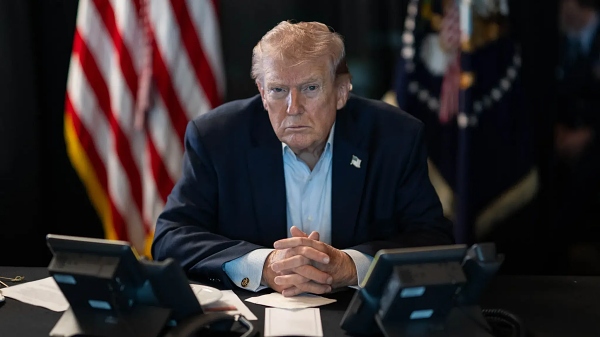
U.S. President Donald Trump made 3,642 stock trades in the first quarter of 2026, the report showed.
On May 14 (local time), blockchain outlet BeInCrypto reported that the disclosure was released as a 113-page U.S. Office of Government Ethics Form 278-T and was viewed as a major departure from the blind trust practice maintained by U.S. presidents in recent decades.
The disclosure shows an average of about 60 trades per reporting period. Since Lyndon B. Johnson, U.S. presidents have mainly placed personal assets in qualified blind trusts to reduce potential conflicts of interest. Jimmy Carter sold his peanut farm, Barack Obama held U.S. Treasuries and index funds, and Joe Biden also used a blind trust while in office.
Trump's first-quarter portfolio included individual purchases of Nvidia, Microsoft, Broadcom, Amazon and Apple. Each purchase was in the range of $1 million to $5 million. By contrast, hundreds of individual sales were listed in ranges from $15,000 to as much as $25 million.
The holdings were concentrated in sectors linked to the administration's policy direction. Semiconductor stocks such as Nvidia, Broadcom and AMD align with policy to expand chip production capacity in the United States. The period also overlapped with continued tariff adjustments targeting Asian supply chains. The inclusion of financial stocks such as JPMorgan, Goldman Sachs and Visa coincided with a deregulation trend that continued into 2026.
Crypto-related stocks were also included. Trump bought shares of Coinbase, Robinhood and SoFi. Those trades took place when the administration was pushing pro-crypto policies. At the time, the U.S. government was pursuing executive orders, a federal bitcoin reserve and the retirement program known as the Trump Account. Robinhood in particular served as an initial custodian for the program, raising concerns about conflicts of interest. The White House said the disclosure fully complied with the current stock-trading disclosure law.
In politics, debate is already under way over banning stock trading by members of Congress. Treasury Secretary Scott Bessent publicly supported a ban on lawmakers trading individual stocks. "I am pushing to ban members of Congress from trading individual stocks," he said, adding, "Public service should be about serving people, not a means to accumulate wealth." The outlet said this logic is increasingly being applied to stock trading by the executive branch as well. But the stock-trading law enacted in 2012 only imposes a disclosure duty on public officials and does not ban trading itself.
The biggest controversy has come from Dell Technologies. The disclosure includes records showing Trump bought Dell shares worth several million dollars several times starting on Feb. 10. On May 8, Trump publicly praised Dell at a White House event, and Dell shares rose about 12 percent the same day. The Dell family had previously pledged $6.25 billion in December 2025 to the Trump Account program.
The issue now is whether the trading pattern will lead to an official investigation. The House and Senate ethics committees and the Office of Government Ethics still have to decide what judgment to make. The disclosure met current reporting rules, but it is becoming a catalyst for broadening a debate over stock-trading regulation that had focused on Congress to include the executive branch. Discussion of rule changes could grow, especially because Trump's trades overlap with sectors that benefit from policy, including semiconductors, finance and crypto.
 Jinju Hong
hongjj@d-today.co.kr
Jinju Hong
hongjj@d-today.co.kr