
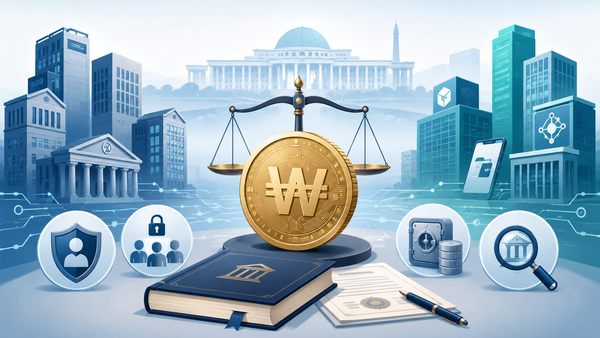
[Digital Today reporter Sangyeop Oh (오상엽)] As stablecoins emerge as a key element of digital currency sovereignty, discussion is picking up in South Korea over introducing them. A push is under way to enact a Digital Asset Basic Act covering who can issue won-based stablecoins, how much reserve assets to require and where to place supervisory authority. But the government, parliament, financial authorities, the Bank of Korea and the industry hold differing views, prompting calls for a fast resolution.
The Digital Asset Basic Act is currently being pursued as second-stage legislation to address overall market structure after the Virtual Asset User Protection Act took effect in July 2024.
While the Virtual Asset User Protection Act focuses on user protection and curbing unfair trading, the Digital Asset Basic Act is intended to set an institutional framework for the broader industry, including issuance and distribution, disclosures, stablecoins and rules for operators.
Earlier, some inside and outside parliament and financial authorities discussed the possibility of completing legislation within the first quarter of this year, but talks have not gained pace. With the submission of a government bill delayed, and with June 3 local elections, the formation of a new parliamentary leadership in the second half and the possibility of a change in the chair of the National Policy Committee also overlapping, the timing of passage has become unclear.
Bills related to stablecoins are pending in parliament, but whether they will be placed on the agenda of the National Policy Committee's bill subcommittee and their prospects for passage are expected to depend on talks between the ruling and opposition parties.
The industry says the longer the legislative vacuum lasts, the harder it becomes to pursue businesses and make investment decisions. Stablecoin-related business is spreading quickly across banks, card firms, fintech, digital asset exchanges and payment infrastructure companies, but the roles different operators can take on have not been legally determined.
◆ Banks and non-banks divided over who can issue
The biggest issue is who can issue won stablecoins. One option under discussion would allow issuance by a consortium in which banks hold at least 50 percent plus one share. It is the so-called 51 percent rule.
The Bank of Korea is closer to the view that a bank-led issuance structure is needed, citing financial stability and the effectiveness of monetary policy. It judges that if stablecoins circulate on a large scale in the private sector, they could affect the deposit-based financial structure and the monetary policy transmission mechanism. There is also concern that if a private digital currency pegged 1-to-1 with the won is used like a means of payment, it could conflict with the central bank's authority over currency management.
By contrast, fintech and the digital asset industry see a bank-centric structure as potentially limiting innovation. They say stablecoins require not only issuance stability but also wallets, payments, settlement, remittances and platform connectivity.
They argue that non-bank operators should be allowed to participate broadly because user-facing service touchpoints are closer to fintech and platform companies than to banks.
Some in parliament also warn that concentrating issuance authority too heavily in banks could repeat an existing closed structure centred on traditional financial firms. But if issuance is allowed for non-banks, separate safeguards would be needed on how to control anti-money laundering, user protection, reserve asset management and redemption responsibility in bankruptcy.
Ultimately, the issuer debate boils down to balancing stability and innovation. A bank-led structure can make it easier to secure financial stability, but it can raise barriers to entry. Expanding non-bank participation can spur competition and service innovation, but it increases the supervisory burden.
◆ Reserve asset obligation is key to user protection
Another issue affecting stablecoin trust is reserve assets. Stablecoins are designed to track the value of fiat currencies such as the won or the dollar. To do so, issuers must hold safe assets such as cash, deposits and government bonds so users can demand redemption at any time.
The questions are the types and ratios of reserve assets and how they are held. Issues include whether to require reserves of 100 percent or more, whether to allow some to be managed in short-term safe assets, and whether customer assets and company assets should be held separately.
Overseas cases show stablecoin regulation focuses on reserve asset transparency. If an issuer cannot hold sufficient assets, the peg can break when large-scale redemptions occur. That can lead not only to user losses but also to instability across payment networks and financial markets.
In South Korea, many say disclosures on reserve assets, external audits and regular reporting obligations are needed. If stablecoins are used not as simple investment products but as payment and settlement tools, issuers' financial soundness and details of reserve asset management are effectively directly tied to the stability of payment infrastructure.
But if reserve requirements are designed to be overly strict, it may become difficult for new operators to enter. In particular, fintech and smaller infrastructure companies may struggle to secure large reserve assets on their own.
This is why some say a division of roles is realistic, limiting issuers to banks while fintech firms and exchanges take on wallet, payment and distribution roles.
◆ Supervision: Financial regulator or central bank
Debate over the supervisory framework is also difficult. The Digital Asset Basic Act is being discussed within a financial regulatory system centred on the Financial Services Commission and the Financial Supervisory Service. But because stablecoins span currency and payments, it is hard to exclude a role for the Bank of Korea.
The Financial Services Commission can take on market supervisory functions such as licensing, regulating business conduct, user protection and responding to unfair trading. The Bank of Korea, however, says it needs to examine stablecoins from the perspective of payments stability and monetary policy. It says that if won stablecoins circulate on a large scale, privately issued digital currencies could have the effect of replacing deposits and cash.
How far to extend the central bank's authority is also an issue. Depending on whether the Bank of Korea is allowed to directly weigh in on issuance structures and reserve requirements or is granted monitoring authority limited to payments stability, the system design will differ.
The industry says the supervisory body must be clear. If the Financial Services Commission and the Bank of Korea have overlapping authority, operators could face duplicate regulation.
Conversely, if the division of authority is unclear, responsibility could become ambiguous when accidents occur. Some also point out that because stablecoins combine payments, investment and remittance functions, a single supervisory framework has limits.
◆ Exchange governance rules also a variable
The Digital Asset Basic Act could also include exchange governance issues beyond stablecoins. The market has discussed limiting the shareholding cap for a major exchange shareholder to about 15 to 20 percent. The aim is to prevent excessive concentration of fee revenue and market influence in a single major shareholder.
Some in the government and political circles say governance transparency should be improved because digital asset exchanges could become key financial infrastructure in the future. The argument is that conflicts of interest should be reduced and market trust secured through reviews of major shareholders' qualifications and limits on shareholdings.
The industry, however, worries that shareholding limits could undermine management stability. Exchanges require large capital for technology investment and security, overseas expansion and new service development. They argue that artificially lowering major shareholders' stakes could weaken responsible management and put them at a disadvantage in competing with overseas operators.
In particular, separating issuance and distribution functions is also up for discussion. There is concern about conflicts of interest if a stablecoin issuer operates an exchange, wallet and payment infrastructure at the same time. Others counter that to vitalise the industry, issuance, distribution and payment functions need to be organically connected.
This issue could also affect future partnership structures among banks, fintech firms, exchanges and platform companies. Strictly separating issuance and distribution would complicate consortium structures, while easing regulation would increase the possibility of certain operators dominating the market.
◆ Global race accelerates as South Korea coordinates
As domestic discussions are delayed, overseas moves to institutionalise digital assets are moving quickly. In the United States, debate continues on the GENIUS Act, which includes stablecoin rules, and the CLARITY Act, which addresses digital asset market structure.
The GENIUS Act has passed the Senate Banking Committee and awaits additional legislative procedures, while the CLARITY Act has set a schedule for Senate review, keeping market-structure rule discussions under way.
The European Union is enforcing rules on digital asset issuance and service providers through the MiCA framework. MiCA's stablecoin provisions applied from June 30, 2024, and the full rules applied from Dec. 30, 2024.
Global big tech and financial firms are also moving. Stablecoins are being linked not only to coin issuance but also to AI agent payments, business-to-business settlement, cross-border remittances and tokenised asset trading. Dollar stablecoins have already entered global payments infrastructure.
Domestic companies are also not simply waiting for passage. Banks are preparing consortia and cooperation with global stablecoin issuers, while fintech firms and exchanges are moving to secure mainnets, wallets, payment networks and settlement infrastructure. Competition to pre-empt the market has effectively begun even before the law is finalised.
The longer the legislative vacuum lasts, the fewer options domestic companies may have. If rules are unclear, it is difficult to make large investments and finalise business structures. By contrast, global operators are already widening links to the domestic market on the back of dollar-based infrastructure.
An industry official said, "A stablecoin market is not created by simply allowing issuance." The official added, "Real usability comes only when reserve asset trust, payment infrastructure, wallet services and distribution networks are built together." The official said, "The later the bill discussions are, the more companies will have no choice but to move first amid uncertainty, and market leadership will be decided in the process."
 Sangyeop Oh
yub@d-today.co.kr
Sangyeop Oh
yub@d-today.co.kr