
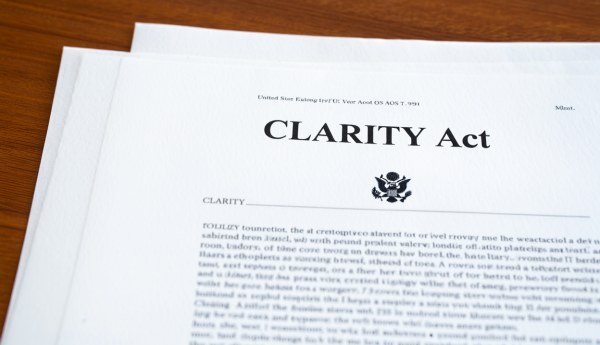
[DigitalToday reporter Yoonseo Lee (이윤서)] Five major U.S. labor unions have formally delivered opposition to the CLARITY Act, a crypto market-structure bill.
On May 13, CNBC reported, citing blockchain outlet CoinPost, that five groups including the AFL-CIO sent a letter to all senators. They urged senators to vote against the bill ahead of a Senate Banking Committee review on May 14.
The groups that joined the letter were the AFL-CIO, the Service Employees International Union (SEIU), the American Federation of Teachers (AFT), the National Education Association (NEA) and the American Federation of State, County and Municipal Employees (AFSCME). They argued the CLARITY Act could harm the stability of workers’ retirement pension systems, including public pensions.
Labor groups view the bill as seeking to incorporate cryptocurrencies into the real economy without sufficient regulatory safeguards. In an email to lawmakers on the Senate Banking Committee, the AFL-CIO argued the approach could destabilise the financial system and benefit issuers and platforms while disadvantaging workers.
The groups criticised the bill in particular for distorting where risk ultimately falls. The joint letter said, "This bill would allow the cryptocurrency industry to take on excessive risks, and if that bet fails, the people who pay the price will be workers and retirees, not the industry’s billionaires." It also cited as a problem that funds backing retirement pensions and savings accounts could be exposed to market volatility.
The Senate Banking Committee on May 12 released a revised draft of the CLARITY Act spanning 309 pages. The committee is set to review the draft on May 14. The bill includes provisions to overhaul the U.S. crypto regulatory framework, including dividing jurisdiction between the Securities and Exchange Commission (SEC) and the Commodity Futures Trading Commission (CFTC), rules related to stablecoins and a restriction on central bank digital currency (CBDC).
The biggest issue in the revised draft is provisions over stablecoin interest and yield offerings. The draft would prohibit interest or yield payments on stablecoins that are "economically and functionally equivalent" to bank deposits. It was adjusted, however, to allow user rewards tied to transaction and usage performance.
The provision has already caused one delay in deliberations. In January, Coinbase Chief Executive Brian Armstrong (브라이언 암스트롱) withdrew support in protest of the yield ban, and review was then postponed indefinitely. Senator Thom Tillis (톰 틸리스) and Senator Angela Alsobrooks (앤절라 알소브룩스) later stepped in to mediate, and a compromise was reached on May 1.
Companies show diverging interests over the revised draft. Coinbase and Circle support the structure that allows rewards tied to transactions and use. Labor groups, however, say the bill’s overall direction remains unchanged despite some adjustments. They argue that allowing market expansion without sufficient safeguards could harm the stability of the broader financial system.
That makes the Senate Banking Committee review on May 14 a watershed in disputes over the direction of U.S. crypto regulation and the scope of investor protection. With labor groups putting retirement pension and savings-account risks at the forefront, a key issue will be how strong a defence the revised draft provides.
 Yoonseo Lee
yslee@d-today.co.kr
Yoonseo Lee
yslee@d-today.co.kr