
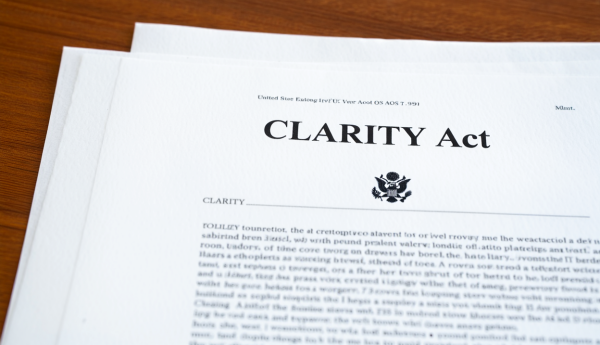
The U.S. Senate Banking, Housing and Urban Affairs Committee will hold a markup on May 14 (local time) for the crypto market structure bill known as the CLARITY Act (CLARITY).
According to blockchain media outlet CoinPost on May 9, the committee added the meeting to its official schedule, and it will be livestreamed.
The bill is legislation the U.S. crypto industry has pushed as its top priority in Congress. Its core provisions split oversight authority for digital assets between the U.S. Securities and Exchange Commission (SEC) and the Commodity Futures Trading Commission (CFTC), and set standards for whether a token is a security or a commodity. It also includes new disclosure requirements for crypto exchanges and stablecoin issuers.
Committee Chairman Tim Scott has previously released a 278-page bipartisan amendment reflecting months of negotiations earlier this year. The stablecoin interest provision, long seen as the biggest sticking point, has been partly settled after a compromise emerged last week. The compromise would block simple interest on account balances but allow rewards linked to transaction activity.
Paul Grewal (폴 그레월), Coinbase's chief legal officer, said at "Consensus 2026" in Miami that the proposal preserves the transaction-linked rewards that matter most to Coinbase and called it a "compromisable middle ground". He also pushed back against banks' claims that deposits would flow out, saying, "The financial industry has not presented any real basis to support this. The evidence is zero."
Banks are seeking additional changes. Six groups including the American Bankers Association (ABA) sent a joint letter to the Senate Banking Committee's Republican leadership, arguing that the current language makes the interest ban too narrow and could effectively leave long-term holder rewards intact. They called for narrowing the scope of exceptions and revising the provision to broadly prohibit any payments that are substantially similar to interest.
The bill's next dispute is over ethics provisions. According to a POLITICO report, Democrats want language restricting digital asset conflicts of interest for federal officials included in the bill text. Republicans said the provision falls outside the committee's jurisdiction and could be added after committee passage but before the bill moves to the floor, but Democrats are not accepting that approach.
Senator Kirsten Gillibrand (커스틴 질리브랜드) said at the Consensus event last week that "there is no Democrat who will vote for this bill if it doesn't have an ethics provision". The provision Democrats are seeking is discussed as limiting lawmakers, senior administration officials, the president and the vice president from using insider status to profit from the crypto industry.
Behind the dispute is the expansion of crypto-related interests tied to U.S. President Donald Trump's family. Trump and Melania Trump issued meme coins in January 2025 before taking office, and the Trump family is listed as co-founders of World Liberty Financial (WLFI), a DeFi and stablecoin business. The family also holds a 20 percent stake in mining company American Bitcoin (ABTC) and is also linked to the stablecoin USD1. Bloomberg estimated the value of Trump's crypto-related businesses at at least $1.4 billion.
Patrick Witt (패트릭 위트), executive director of the President's Advisory Council on Digital Assets, set July 4 as the target date for enactment. He said, "We are aiming for July 4," and laid out a timetable in which the Senate would pass the bill in June and then coordinate with the House. The White House, however, said it would not accept an ethics provision that targets a specific individual or office. Witt said the rules should apply equally from the president to congressional interns.
Ultimately, three issues are expected to be central at the May 14 markup. The focus will be whether changes sought by banks to the interest provision are reflected, whether the ethics language Democrats want enters the bill text, and whether the White House's July 4 target remains in place. Passage at the committee stage is possible given the Republican majority, but securing the 60 votes needed to overcome a filibuster on the Senate floor will not be easy without Democratic cooperation.
 Yoonseo Lee
yslee@d-today.co.kr
Yoonseo Lee
yslee@d-today.co.kr