
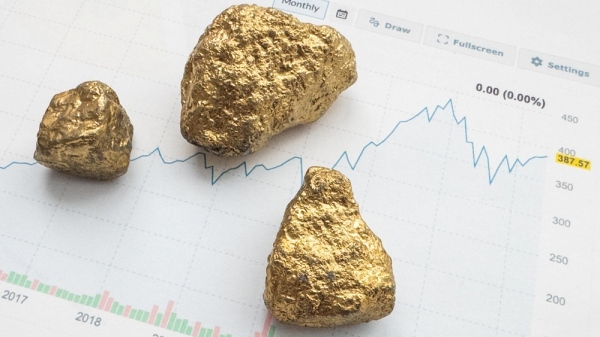
Global spot gold exchange-traded funds (ETFs) drew $6.6 billion in April, breaking out of a sharp outflow the month before.
Blockchain media outlet BeInCrypto reported on May 10 that $12 billion flowed out of spot gold ETFs in March, the largest monthly outflow on record. In April, flows turned back to net inflows.
The rebound came as the slide in gold prices eased. Spot gold prices fell 13 percent in March and slipped another 1.12 percent in April, but the decline narrowed sharply from the previous month. March marked the biggest monthly drop since 2008, and April saw some easing in price volatility, which is seen as bringing investment money back in.
By region, Europe led the rebound. Spot gold ETFs in Europe took in $3.7 billion, while Asia and North America posted net inflows of $1.8 billion and $1.0 billion, respectively. All regions contributed to April inflows. Since the start of the year, cumulative net inflows into global spot gold ETFs totalled $19.0 billion.
Assets under management also rose with the inflows. Total assets under management increased 1 percent from the previous month to $615 billion. Gold holdings rose by 45 tonnes to 4,137 tonnes, the third-highest level on record. The market views April’s moves as a sign that March’s sharp exodus was temporary.
China’s gold buying also continued. The People’s Bank of China (PBoC) bought more than 8 tonnes of gold in April, extending its buying streak to 18 straight months. The April purchase was the biggest since December 2024, lifting total holdings to about 2,322 tonnes. It also bought 5 tonnes in March, taking two-month purchases to the largest increase since the first quarter of 2025.
The market focused on the fact that the Chinese central bank has kept buying through a correction. Research firm Kobyashi Letter said, "Since the start of the year, China’s central bank has bought more than 15 tonnes of gold," adding it is "heading toward the largest annual purchase volume since 2023." It also said, "China sees a gold correction as a buying opportunity."
Whether the rebound in spot gold ETFs continues depends on external factors. April’s moves showed gold is still functioning as a core asset in portfolios, but Middle East tensions and the U.S. Federal Reserve’s interest-rate outlook remain factors that could influence flows. In March, tensions between the United States and Iran weighed on the gold market, triggering record outflows from spot gold ETFs.
The April figures are seen as an example of how quickly money can return after a sharp price drop. Europe and Asia led the recovery, and China’s central bank kept buying through volatility, supporting the demand base. As a result, the spot gold ETF market is expected to again react sensitively to price stability, geopolitical factors and shifts in monetary policy expectations.
 Yoonseo Lee
yslee@d-today.co.kr
Yoonseo Lee
yslee@d-today.co.kr