
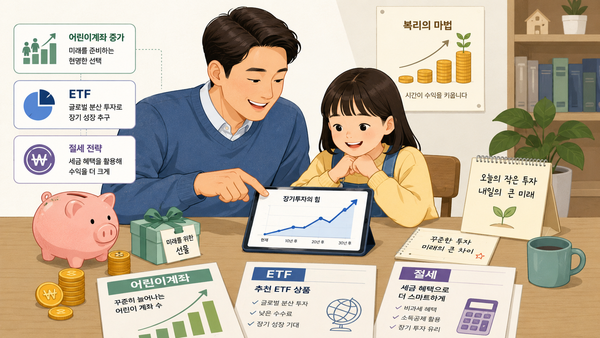
With stocks rising and demand growing for children’s financial education, the number of investment accounts opened in minors’ names is increasing rapidly. Children’s asset management, once largely limited to kids’ passbooks or saving Lunar New Year gift money, is expanding to exchange-traded funds (ETFs), regular savings-type funds, pension savings accounts and gold investments.
On May 7, the financial investment industry said Daishin Securities’ recent analysis of new account openings by age showed the growth rate for new accounts opened for children aged 0 to 9 in April was 119.2 percent compared with January. The increase rate for new accounts opened by teenagers was tallied at 101.1 percent.
Shinhan Investment’s analysis of first-quarter account openings for minor clients and domestic and overseas stock trading data also showed the number of accounts opened for minors rose 272 percent from a year earlier. The average balance per minor account was about 10 million won.
Despite the rise in account numbers, investment balances in newly opened accounts fell in some age groups. Daishin Securities said investment balances in new accounts for children aged 0 to 9 fell 6.0 percent from January, while balances for teenagers fell 28.1 percent.
The shift is seen as reflecting growing demand to open accounts in children’s names with small amounts rather than depositing large sums at once, while combining long-term investing with financial education.
The securities industry cites rising stock markets, wider investment experience among parents, the convenience of opening accounts on mobile devices and interest in children’s financial education as factors behind the increase in minor accounts. It says accounts in children’s names are being used beyond simple pocket-money management as tools for long-term asset building and economic education.
A leading product choice is ETFs tied to major U.S. indexes. ETFs tracking the S&P 500 are often mentioned as long-term investment products because they allow diversified investment in large U.S. blue-chip stocks. An advantage is that they reduce the burden of investing in a specific company while allowing participation in broader growth in the U.S. stock market.
For those interested in technology growth stocks, U.S. big tech ETFs can also be an option. That is because they can provide exposure to long-term growth industries such as artificial intelligence (AI), cloud, semiconductors and platform companies.
For investors more familiar with the domestic market, alternatives include the KOSPI200, high-dividend stocks and funds focused on domestic blue chips. Domestic equity ETFs and funds can make it easier to explain domestic corporate structures and dividend policies to children and involve a relatively smaller burden from exchange-rate fluctuations. If managed as long-term regular investments, they can also be expected to spread out purchase timing amid market swings.
Theme-based ETFs that include future industries such as physical AI, robots, semiconductors and power infrastructure have also been drawing attention recently. Theme products, however, can have large price fluctuations as well as high growth potential.
A practical approach for children’s accounts is to allocate only part of total assets and build core assets around broadly diversified index products.
From a tax perspective, the timing of gifts, reporting and the type of account matter. Under current tax law, minors can receive a gift-tax deduction of up to 20 million won over 10 years from direct ancestors such as parents or grandparents.
After reaching adulthood, a deduction of up to 50 million won over 10 years is available. It is important to note that the limit is not structured so each parent can give 20 million won separately, but is determined by combining amounts received from direct ancestors.
For example, if 20 million won is gifted at a child’s birth and another 20 million won is gifted 10 years later, a total of 40 million won can be transferred during the minor period without gift tax.
After adulthood, the 50 million won deduction limit can be used. If the asset value rises after the gift, the increase is in principle not viewed as an additional gift, so the tax-saving effect can grow when combined with long-term investing.
Even if no gift tax is due, it is safer to report the gift. The deadline for filing a gift tax return is within 3 months from the end of the month in which the gift date falls. That is because the filing record can serve as a basis later when explaining the source of funds or determining whether additional gifts were made.
When gifting stocks directly, the valuation method should also be considered. Listed stocks are typically valued based on the average of final market prices over a total of 4 months, covering 2 months before and 2 months after the gift date.
Depending on share-price moves, the assessed gift value may be larger than expected. For that reason, a simpler approach may be to gift cash first and report it, then buy long-term investment products in the child’s account.
Caution is also needed when parents effectively manage a child’s account. If frequent trading occurs in a minor’s account or large profits arise from a parent’s investment decisions, the child’s account could appear in effect like a parent’s nominee account. If the purpose is financial education, regular contributions, long-term holding and keeping investment records are preferable to short-term trading.
Tax variables also need to be checked for overseas stock investment. Overseas stocks are subject to capital gains tax on the amount remaining after subtracting a basic annual deduction of 2.5 million won from annual capital gains. The tax rate including local income tax is typically around 22 percent.
If a child’s annual capital gains exceed 1 million won, the child may also be excluded from a parent’s year-end tax adjustment dependent deduction. Separate checks are needed for the dependent-deduction test even within the 2.5 million won basic deduction bracket, where no tax is actually due.
Domestically listed overseas equity ETFs are taxed differently from individual overseas stocks. In a standard account, trading profits and distributions from domestically listed overseas equity ETFs are taxed as dividend income.
If financial income such as dividends and interest is 20 million won or less a year, it is subject to separate taxation, but if it exceeds 20 million won it may become subject to comprehensive taxation of financial income. That is why the larger a child’s account becomes, the more important it is to check the tax structure by product.
Pension savings accounts are cited as tax-saving accounts. Pension savings have no age restriction, and minors without income can also open them. It is not possible, however, to directly trade individual stocks or overseas stocks in a pension savings account. The account is managed mainly through domestically listed ETFs and funds.
Investment income generated within a pension savings account is not taxed immediately and taxation is deferred until withdrawal. Principal contributions that did not receive a tax credit are not taxable upon withdrawal, and investment income is subject to pension income tax if pension-receipt requirements are met.
If the account is terminated early or funds are received for purposes other than a pension, other income tax burdens may arise, so it should be used in line with long-term objectives.
For gold investment, KRX gold trading accounts are mentioned as a tax-saving tool. Gold ETFs or bank gold accounts may face dividend income tax on trading gains, and physical gold has the advantage of tax-free trading gains but involves value-added tax and fabrication fees.
KRX gold trading accounts have the advantage that capital gains tax and dividend income tax are not imposed on trading gains from on-exchange transactions. If withdrawn as physical gold, however, value-added tax and delivery costs may arise, so it should be distinguished from the goal of long-term holding within the account.
Ultimately, the core of a child’s account is structure rather than return. The necessary order is to first transfer funds by using 10-year gift-tax deduction limits and leave filing records, then choose products suited to long-term diversified investment.
A suitable approach is to build the portfolio mainly around major U.S. index ETFs, domestic blue-chip and dividend ETFs, and long-term regular savings-type funds, while using theme-based ETFs as a supplementary allocation.
An industry official said, "Minor accounts should be viewed less as accounts to generate short-term profits and more as a means to teach children investment principles, risk management and the process of building long-term assets." The official said gift reporting, the tax structure and managing investment records are as important as product selection.
 Oh Sang-yup
yub@d-today.co.kr
Oh Sang-yup
yub@d-today.co.kr