
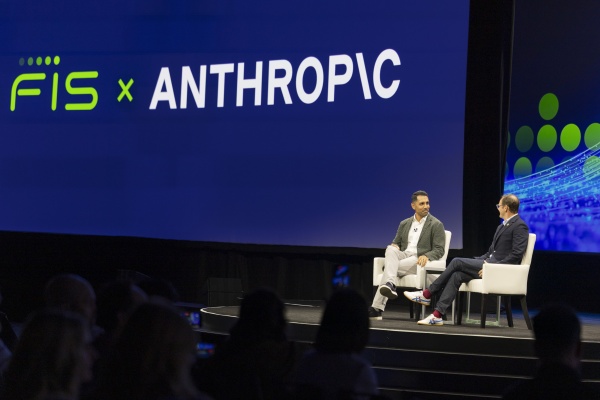
Financial technology company FIS is developing a financial crime artificial intelligence (AI) agent with Anthropic to cut anti-money laundering (AML) investigation times from hours to minutes.
A fintech outlet, Finextra, reported on May 5 local time that the agent is designed to automatically gather evidence across banks' core systems, compare transaction activity against known patterns and prioritise high-risk cases for investigators.
The collaboration focuses on automating repetitive and time-consuming AML work in finance. The new agent compresses steps in which investigators moved across multiple systems to collect and organise materials, helping them identify cases requiring review more quickly. The key is that it is structured to carry out evidence collection and risk assessment within the actual investigation workflow, rather than serving as a simple support tool.
Early adopters include Bank of Montreal (BMO) and Amalgamated Bank. The two banks plan to deploy the system first, and FIS plans broader supply in the second half of 2026. The project is moving beyond proof of concept to the stage of applying it in real banking work environments.
The development approach also stands out. Anthropic's applied AI team and deployment engineers are participating within FIS to jointly design the agent. FIS plans to receive technology and operational know-how through the process and build a system enabling it to develop and scale additional agents on its own.
The two companies' roles are also clearly divided. FIS is responsible for the foundation, including the data platform, governance layer, deployment infrastructure and customer relationships. Anthropic's Claude model handles reasoning across the strategy. For financial companies, the structure applies AI on top of existing systems and data control frameworks, while the model focuses on decision support.
Stephanie Ferris (스테퍼니 페리스), FIS chief executive officer and president, said what banks want is not AI that assists but AI that acts. She said the future is for FIS to manage customer data and agent governance and stand as a trusted provider between customers and AI that makes decisions related to funds. She added that Claude serves as the internal reasoning engine and stressed that the financial crime AI agent is the first example of what this structure can provide to financial institutions.
Ferris also said banks of the future will adopt an agent-first strategy. She described the project as a new era for banking. FIS is also considering a direction of independently developing and scaling additional agents on its own foundation starting with this collaboration.
Against this backdrop, the announcement shows that financial firms' adoption of AI is moving beyond simple support for counselling or document summarisation to core operational tasks such as regulatory compliance and risk detection. It also showed that as FIS chose a structure in which it directly handles data, governance and deployment infrastructure and combines Anthropic's model, the focus of AI adoption in finance is shifting toward controllable operating systems rather than the model's performance itself.
A new era of banking starts here. FIS and @ai_anthropic are bringing AI agents into core banking systems, marking a fundamental shift to agent-driven operations. First use case: financial crime, cutting AML investigations from days to minutes.https://t.co/WGNDg2SH3O pic.twitter.com/zwGpD4L9EZ
 Yoonseo Lee
yslee@d-today.co.kr
Yoonseo Lee
yslee@d-today.co.kr