
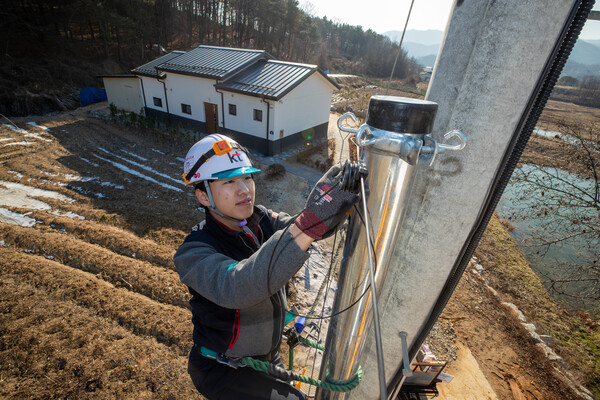
KT will build a wireless network-based local telephone service, the first among South Korean telecom operators.
The Ministry of Science and ICT on May 6 held a meeting of the ICT regulatory sandbox deliberation committee for new technologies and services and newly designated four regulatory exemptions, including a "local telephone service using a wireless network (LTE)" and an "AI-based severe trauma patient care system". The latest designations bring cumulative approvals since the ICT regulatory sandbox was introduced in 2019 to 300 cases.
KT's LTE-based local telephone service replaces part of the subscriber section of the existing wired network-based local phone service with LTE. Previously, users applying for a wired phone line in island and mountainous areas where installing poles or conduits is difficult had to bear substantial construction costs. KT explained that the test exemption now makes it possible to provide communications services at the same level as existing local phone service, without building separate lines, in rural fishing villages, island and mountainous areas and outlying areas where installing wired local phone service is difficult.
Hyung-min Han (한형민), head of KT's CR office and an executive vice president, said the designation was meaningful in that it laid the groundwork to resolve connectivity blind spots in areas where building wired networks is difficult. He said KT would continue working to improve access to universal communications services.
An AI-based severe trauma patient care system by Ajou University Industry-Academic Cooperation Foundation was also designated for a regulatory exemption. The service installs fixed video information processing devices, such as CCTV, in trauma resuscitation rooms to collect actual emergency treatment footage, de-identifies it and uses it for medical AI, including support for automatically drafting medical records.
Under the current Personal Information Protection Act, prior consent from the data subject is required to collect and use footage from enclosed places that could include personal and sensitive information, but it was difficult to obtain prior consent given the nature of severe trauma centres. The exemption makes it possible to use de-identified footage, including for medical AI training, on the premise of obtaining consent afterward.
The ministry also designated a test exemption for a system in which AI analyses fault types through a remote power management system installed at electric vehicle charging stations and can resolve charger software errors or temporary power problems remotely.
The Ministry of Science and ICT will also convert a city guesthouse business that only foreigners can use into a temporary permit for a shared accommodation service that both Koreans and foreigners can use. It also converted a test exemption allowing commerce broadcast services on cable TV local channels into a temporary permit so the service can continue.
Je-myung Ryu (류제명), the ministry's second vice minister, said the ICT regulatory sandbox had reached 300 regulatory exemption designations as of today. He said the ministry would pursue more reasonable institutional improvements based on accumulated test experience and data gathered through the regulatory sandbox.
 Jin-ho Lee
jhlee26@d-today.co.kr
Jin-ho Lee
jhlee26@d-today.co.kr