
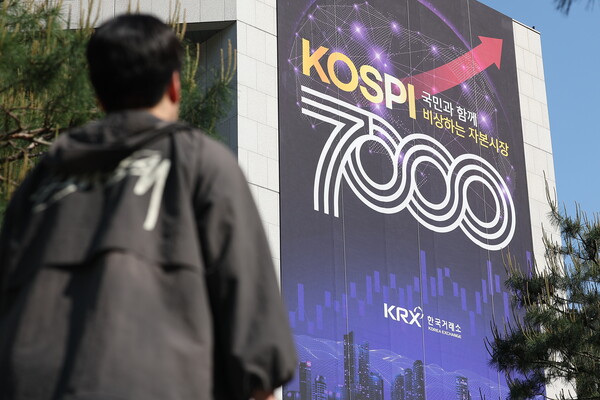
The KOSPI has risen above the 7,000 mark for the first time ever. The benchmark set a new record as improved semiconductor conditions from expanded artificial intelligence (AI) investment combined with earnings expectations for key industries and the effects of capital market advancement policies, an analysis showed.
According to the Korea Exchange, the KOSPI rose as high as 7,426.60 intraday on Tuesday before closing at 7,384.56. It topped 7,000 about 2 months after it first broke above 6,000 on Feb. 25, when it stood at 6,083.86.
The KOSPI's market capitalisation also hit a record 6,058 trillion won. That is more than 1,000 trillion won higher than 5,017 trillion won when it first crossed 6,000.
The KOSPI has gained 75.2 percent so far this year. That is the highest among benchmark indexes in the Group of 20 countries. The Korea Exchange said Turkey's stock market rose 28.7 percent over the same period, Japan gained 18.2 percent and Brazil advanced 15.9 percent.
Semiconductors were at the centre of the stock market rise. Expectations for improved semiconductor earnings grew as expanded global AI investment combined with rising demand for high-performance memory.
Semiconductor exports in April jumped 173 percent from a year earlier to $31.9 billion. That followed $32.8 billion in March, keeping exports at a high level.
Improving semiconductor conditions spread beyond the electrical and electronics sector to power equipment, construction infrastructure and the materials, parts and equipment industries. That also strengthened sector rotation.
Since the start of the year, the electrical and electronics sector has risen 124.8 percent, construction has gained 129.2 percent, machinery and equipment has climbed 78.5 percent, and transport equipment and parts has added 39.6 percent.
Foreign flows also supported the index rise. Foreign investors posted net sales of 21.1 trillion won in February and 35.9 trillion won in March on the KOSPI market, but turned to net buying of 1.1 trillion won in April.
In May, they expanded net purchases to 6.1 trillion won. They posted net buying of 2.3 trillion won in April and 6.0 trillion won in May in the electrical and electronics sector in particular.
Key industries including defence, shipbuilding, nuclear power and construction also helped lift the index. Strength in defence and construction continued as rising geopolitical tensions increased security demand and expectations grew for overseas infrastructure reconstruction orders.
Shipbuilding and machinery and equipment related to nuclear power also rose together as the importance of energy security increased and supply chain reshuffling progressed.
Expectations for capital market advancement policies also amplified a re-rating trend in corporate values. An assessment said improvements such as boosting shareholder value and cracking down on unfair trading combined with companies' voluntary expansion of shareholder returns, leading to improved investor sentiment.
The first to third rounds of revisions to the Commercial Act provided a legal basis for improving corporate governance. The implementation of separate taxation on dividend income and expanded tax support for companies deemed excellent in value-up programmes also raised expectations for shareholder returns.
The KOSPI's move above 7,000 also carries meaning as a change in standing within global capital markets, beyond the domestic market's quantitative growth. With the KOSPI's market capitalisation increasing to 6,058 trillion won, the total market capitalisation of South Korea's stock market has risen to around eighth in the world.
Its higher resilience than major markets despite geopolitical uncertainty is also cited as a factor that boosted investor trust.
Still, concerns remain after the sharp short-term rally. The potential for profit-taking, geopolitical uncertainty including the United States and Iran, and shifts in major countries' monetary policy are cited as variables for future market moves.
A Korea Exchange official said, "Expanded AI demand, improved earnings across sectors, and the continued effect of capital market advancement policies are expected to drive the index higher." The official added, "Profit-taking demand due to the sharp short-term rally, geopolitical uncertainty, and uncertainty over major countries' monetary policy are factors to watch."
 Sang-yeop Oh
yub@d-today.co.kr
Sang-yeop Oh
yub@d-today.co.kr