
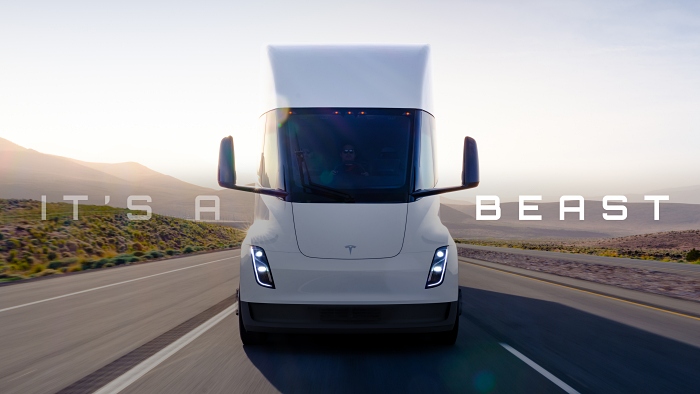
Tesla's heavy-duty electric truck, the Semi, has secured large orders in the hundreds, led by U.S. port logistics operators. It is showing signs of shifting from simple pilot runs to full commercial deployment.
Electrek reported on May 5 that California-based logistics and charging infrastructure companies have recently signed contracts for Tesla Semis in the hundreds, reshaping the electric truck market. It said large-volume procurement through charging solution provider WattEV and Forum Mobility signals electric trucks are emerging as a viable alternative to diesel on economics and practicality, pointing to rapid market growth.
The most notable order is a 370-truck contract announced by WattEV. It is the largest single electric truck deployment in California, with more than 300 of the trucks set to be assigned to an Oakland port operations program.
Separately, Big F Transport and NICA Container Freight Line ordered 40 and 20 Semis, respectively, for a total of 60, through charging infrastructure provider Forum Mobility. The companies plan to concentrate the vehicles on port drayage work transporting containers at the ports of Los Angeles and Long Beach.
Port logistics has rapidly emerged as a core market for the Tesla Semi because of operating patterns suited to electric trucks. Short, repetitive routes between ports and nearby warehouses provide predictable daily mileage and are well suited to operations based on dedicated charging hubs. An analysis that the Semi can cut costs by more than $400,000 over its lifetime compared with diesel trucks is translating total cost of ownership competitiveness into buying decisions in a commercial vehicle market with high fuel-cost exposure.
Signs are also clear that market leadership is shifting to Tesla. Big F Transport, which previously operated nine Daimler eCascadia trucks, switched models by ordering 40 Tesla Semis after real-world driving tests, drawing attention because the move was based on operating experience.
WattEV, which had introduced at least 36 Nikola trucks, a brand once described as a Tesla rival but later bankrupt, also ultimately chose Tesla through an open bid, another sign of a market reversal. California subsidy application data show the Tesla Semi accounts for about 90 percent of total applications, outpacing traditional truck makers such as Daimler and Volvo. That suggests the broader market, not just isolated cases, is increasingly tilting to one side.
Infrastructure and production systems to support operations have also moved onto a firm footing. Tesla has recently begun running a Semi-only production line at its Nevada Gigafactory, spanning 1.7 million square feet with annual capacity of 50,000 units. It has also disclosed 64 Megacharger locations across 15 states and launched a corporate charging programme, "Semi Charging for Business", accelerating ecosystem build-out. Partners such as WattEV and Forum Mobility are providing integrated solutions that combine vehicle leasing with megawatt-class charging infrastructure through a Truck-as-a-Service model, removing upfront capital burdens for individual carriers.
Industry experts view that if Tesla keeps its production line stable, a substantial share of early output will be quickly absorbed by waiting demand already secured. The economic utility of electric trucks proven in port logistics is likely to spread to medium- and long-haul transport, and the latest large contracts are expected to help the Tesla Semi emerge as a leading option in the commercial vehicle market.
WattEV to order 370 Tesla Semis https://t.co/PHP7seEHex
 Kyung-min Hong
hongm@d-today.co.kr
Kyung-min Hong
hongm@d-today.co.kr