
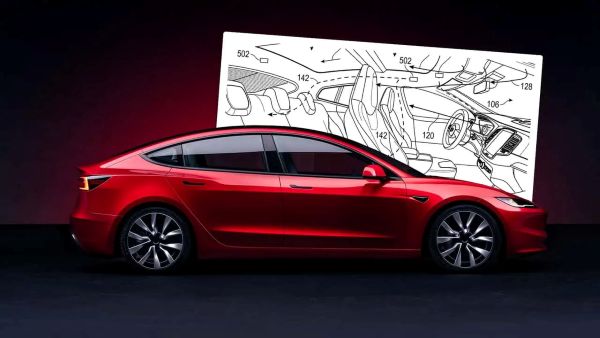
[DigitalToday intern reporter Seung-a Yoo] Tesla has disclosed a patent for a new climate-control technology that selectively draws in hot zones inside a vehicle cabin to improve cooling efficiency.
According to electric-vehicle media outlet InsideEVs on May 5 (local time), the patent focuses on reducing cooling power consumption and lowering driving-range loss.
The core of the technology is adding a suction function to an existing heating, ventilation and air-conditioning (HVAC) unit. It creates negative pressure (vacuum) at specific points inside the vehicle to pull in hot air, sends it to the climate-control system, then readjusts and circulates it with other cabin air. Tesla explained that this allows it to focus first on areas that need cooling, rather than cooling the entire cabin at once.
A representative situation the technology targets is solar radiant heat. When heat entering through a glass roof or windows concentrates in certain areas, such as around passengers' arms and legs or the space above their heads, occupants can feel hotter regardless of the cabin's average temperature. The larger the cabin space and glass area, as in the Model X, the larger the area that requires cooling.
Tesla stated in the patent that its goal is to "maximize thermal comfort and minimize energy consumption." That means prioritising the suction of air only from heat-concentrated zones and evening out temperatures can deliver the same cooling effect with less power.
The patent materials say that under an outside temperature of about 40 degrees Celsius, air-conditioning power consumption can be reduced by up to 7.4 percent. The power saved is about 127 watts (W), with the system's maximum power draw falling to 1,593W from 1,720W. In electric vehicles, cooling load directly leads to reduced driving range, so the figures may look small but amount to a practical efficiency improvement.
Tesla also presented an option to activate the suction function conditionally only in needed areas after sensing cabin temperature, rather than running it constantly. The patent states that it "can be activated only in areas requiring cooling" and links sensors with climate-control management to reduce unnecessary power use.
The impact of summer cooling load on electric-vehicle efficiency has already been confirmed. Recurrent research found that under an outside temperature of about 38 degrees Celsius, driving range can fall by up to 18 percent from air-conditioner use alone. If Tesla's technology is applied to mass-produced vehicles, it could help offset cooling-related range loss without increasing battery capacity or improving the powertrain.
Still, the disclosure remains at the patent stage. Whether it will be applied to production vehicles has not yet been decided.
 Seung-a Yoo
ysah@d-today.co.kr
Seung-a Yoo
ysah@d-today.co.kr