
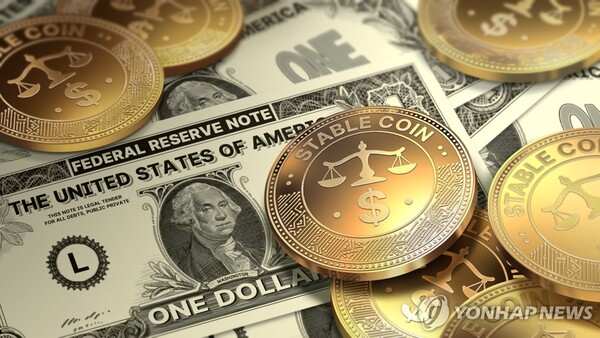
South Korea's crypto market is broadly weakening, with investors' holdings and trading value plunging to about half of peak levels, while demand for dollar-based stablecoins continues to post clear gains.
Data submitted by the Bank of Korea to lawmaker Cha Gyu-geun (차규근) of the Rebuilding Korea Party on the National Assembly's Finance and Economy Planning Committee showed domestic crypto holdings totalled 60.6 trillion won as of end-February this year.
The figure is the sum of crypto asset prices held by investors with accounts at South Korea's five largest crypto exchanges — Upbit, Bithumb, Korbit, Coinone and Gopax — based on market prices at month-end. The amount of crypto holdings rose steadily from 50.6 trillion won at end-August 2024 and peaked at 121.8 trillion won in January last year, before shrinking to less than half by end-February this year.
Trading volumes and standby funds also contracted. Average daily crypto trading value rose to 17.1 trillion won at end-December 2024, but stood at about 4.5 trillion won at end-February this year. Won deposits, also seen as standby investment funds at crypto exchanges, fell to 7.8 trillion won at end-February this year from 10.7 trillion won at end-December 2024.
Stablecoin holdings, however, gradually rose from 88.5 billion won at end-July 2024 and peaked at 872.3 billion won at end-December last year. As of end-February this year, they stayed relatively large at 607.1 billion won.
Market experts cited a shift of funds driven by a stock market rally and exchange rate volatility as reasons for the trend.
Hong Sung-wook (홍성욱), an analyst at NH Investment & Securities, explained: "A shift of investment funds driven by a rally in the domestic stock market and falling crypto prices likely had a big impact on the decline in domestic crypto holdings."
Kim Min-seung (김민승), head of Korbit's research centre, said: "Moves in the won-dollar exchange rate appear to have affected demand for stablecoin investment." He added: "With most coins also weakening on overseas exchanges, it could also be seen as investment funds that went abroad returning to the domestic market."
 Online Team
d-today@d-today.co.kr
Online Team
d-today@d-today.co.kr