
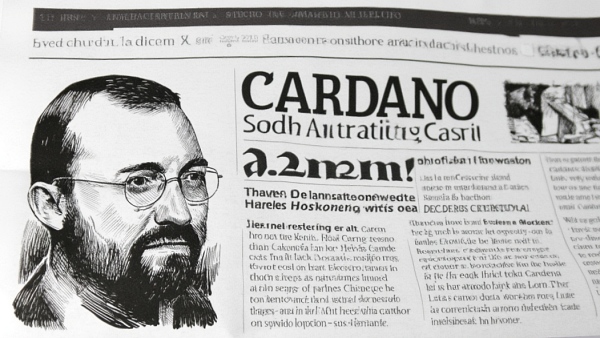
[DigitalToday reporter Yoonseo Lee] Cardano (ADA) founder Charles Hoskinson (찰스 호스킨슨) directly criticised Ripple CEO Brad Garlinghouse (브래드 갈링하우스) over the U.S. CLARITY Act.
On May 1, blockchain outlet The Crypto Basic reported that Hoskinson said in a recent interview that some industry leaders support the bill for their competitive interests rather than for the broader ecosystem.
The issue is that the current bill could significantly change how cryptocurrencies are legally classified. Hoskinson said that under the current draft, many major projects launched today could be classified as securities. He cited Ethereum, XRP and Cardano as examples and said the growth paths seen in the past could now be blocked.
Hoskinson said early crypto projects were able to build communities, secure liquidity and develop real-world use cases amid legal uncertainty. He argued that if that room disappears, new projects will struggle to reach the same level of adoption. He added, "Ripple won its lawsuit under ambiguous laws, but if it had been founded today under this bill, XRP would also have become a security."
He also laid out a standard for the legislative debate. He said it should examine whether projects that are successful now could grow in the same way under the new rules. If not, he argued, the bill’s design itself could have problems. He also compared it to the 1990s, saying overly strict internet policy would likely have prevented companies like Amazon or Google from emerging. Hoskinson said the CLARITY bill could repeat the same mistake in the crypto industry.
It also directly clashed with Garlinghouse’s stance. Garlinghouse has described the bill as a framework that can work in practice, arguing that clarity is better than confusion. By contrast, Hoskinson claimed supporters such as Ripple are pushing for passage despite knowing the bill’s limits. He said that is based on calculations that it could create a competitive environment favourable to them.
Hoskinson acknowledged that the current proposal could also work to his ecosystem’s advantage. He said competing projects could be classified as securities while projects he is involved in could be less affected. He added, however, that supporting such a bill for personal gain runs counter to industry principles.
Another issue he raised was regulatory enforcement after the bill passes. He said once a system is created, it is difficult to revise later, and it could leave room for regulators to interpret it more strictly. Hoskinson warned that if agencies such as the U.S. Securities and Exchange Commission (SEC) take a hardline approach, almost all new crypto projects could be classified as securities. He added, "Ethereum becomes a security, XRP becomes a security, and Cardano becomes a security," arguing the draft could raise barriers to entry rather than foster innovation.
The debate is leading to conflict over where the U.S. crypto regulatory system should place its weight between fostering the industry and protecting investors. In particular, because market entry conditions for developers and startups could change depending on what standards apply to new projects, conflicts of interest within the industry over the CLARITY Act are expected to continue for the time being.
 Yoonseo Lee
yslee@d-today.co.kr
Yoonseo Lee
yslee@d-today.co.kr