
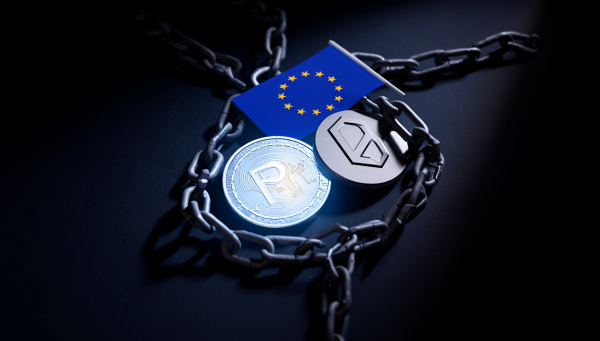
The European Union has imposed a blanket ban on Russia-related cryptocurrency transactions and added the digital rouble being promoted by Russia's central bank and the rouble-pegged stablecoin RUBx to its sanctions list.
On April 28, CoinPost, a blockchain outlet, reported that the EU formally adopted its 20th sanctions package against Russia on April 23 and made the crypto sector a core target.
The key to the measure is a blanket sectoral ban on Russia-based cryptocurrency service providers and decentralised platforms. Previous sanctions focused on energy, finance and trade. This time, the scope has been expanded to include crypto infrastructure. Crypto analytics firm Chainalysis assessed this as entering a "new era" in which cryptocurrency becomes a major sanctions target.
The backdrop is a shift in Russia's payment structure. The Russian government legalised cryptocurrency payments in foreign trade in 2024 in response to Western financial sanctions after its 2022 invasion of Ukraine. The EU views Russia as increasing its reliance on cryptocurrencies in international transactions, and strongly restricted related transactions in this sanctions package.
In particular, the EU did not target only unlicensed networks or self-hosted wallets. It directly targeted the structure Russia has built as an alternative to international payment networks. Chainalysis said the designation of the digital rouble and RUBx directly specified Russia's SWIFT replacement means. Similar regulations were applied to Belarus, and the application period for the related measures was extended to Feb. 28, 2027.
The warning to third-country operators also became clearer. The EU added Kyrgyz exchange TengriCoin to its sanctions list for being deeply involved in trading A7A5, a stablecoin linked to the Russian government. The exchange has also operated under the name Meer.kg. Chainalysis assessed the move as showing that third-country crypto service providers could be exposed to sanctions risk if they handle Russia-linked cryptocurrencies.
Money flows around A7A5 were also cited as a backdrop for tougher sanctions. Chainalysis analysed that A7A5 functioned like a dedicated system connecting sanctioned Russian companies to the international financial system. It said the cumulative processed volume was $119.7 billion, and more than $93.3 billion of that was processed within a year, indicating recent activity expanded sharply.
The EU also moved to block payment infrastructure itself. It added 20 Russian banks connected to the financial messaging network SPFS, described as an alternative to SWIFT, and 4 third-country financial institutions and businesses to a new transaction ban list. Netting transactions with Russia-related entities were also banned. Netting is a method of settling only the difference rather than the gross amount of receivables and payables, and it has been criticised as a structural tool used in Russia-linked transactions to conceal the actual counterparty.
The ban also directly targets so-called layering methods in blockchain transactions, involving multi-layer fund movements via third countries. Chainalysis said such measures are particularly significant from a crypto compliance perspective.
The EU also targeted financial infrastructure that could be used to evade sanctions. Grinex, identified as a successor to Russia-linked exchange Garantex that the United States sanctioned in 2022 for supporting cybercrime activity, halted operations after suffering a cyber attack in April 2026.
China immediately pushed back. China's Commerce Ministry expressed "strong dissatisfaction and firm opposition" to Chinese companies and individuals being included in the 20th sanctions package. It criticised the move as a unilateral sanction without United Nations Security Council approval and as the EU's so-called "long-arm jurisdiction", and demanded the immediate removal of the relevant Chinese companies and individuals from the sanctions list.
China also said the move runs counter to the consensus between China and EU leaders and seriously undermines mutual trust and the stability of bilateral relations. It also said it would "take necessary measures to protect the legitimate rights and interests of Chinese companies" and warned that the EU would have to bear the consequences.
As a result, the EU's latest sanctions are expanding beyond blocking Russia's use of cryptocurrency to pressuring the full range of обход routes, including third-country exchanges and payment networks.
 Yoonseo Lee
yslee@d-today.co.kr
Yoonseo Lee
yslee@d-today.co.kr