
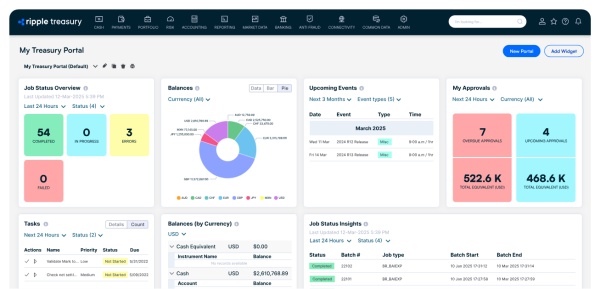
[Digital Today reporter Yoonseo Lee] Ripple has directly integrated XRP and RLUSD into Treasury, its corporate cash management system, prompting discussion of possible changes in corporate treasury operations and payroll payments.
On April 28 local time, blockchain media outlet The Crypto Basic reported that XRP community figure Chad Steingraber (채드 스타인그레이버) said the change could matter not only to companies but also to ordinary employees.
The key point is that digital assets have entered corporate treasury operations directly. Steingraber said many employees are familiar only with receiving wages at regular intervals and often do not know how funds are managed inside a company. He said if a crypto-based real-time payment system takes hold, employees could be paid daily, hourly or even by the minute, and could track income in real time through a blockchain system.
According to his explanation, a corporate treasury is the central system that manages a company’s cash, liquidity and financial risk. This unit checks daily cash flow, reduces risks from interest rate and exchange rate fluctuations, manages banking relationships and invests surplus funds. Treasury management systems are used to monitor balances across multiple banks and currencies in real time and to improve the accuracy of cash forecasting.
Ripple’s integration focuses on reducing inefficiencies in existing treasury systems. Ripple set up a structure to embed its digital asset functions directly into corporate operations after acquiring GTreasury in 2025. As a result, treasury teams can create and manage compliant XRP and RLUSD accounts within their existing systems. It was presented as a change that removes the need for separate wallets, external custodians, crypto exchanges or fragmented workflows.
XRP and RLUSD balances are now displayed within the same financial system alongside fiat cash accounts. It also provides real-time fiat valuation, automated accounting and integrated visibility. For companies, it effectively combines traditional cash management and blockchain-based asset management into a single framework.
There is also a shift in cash management efficiency. With XRP integrated into Ripple Treasury, finance teams can check digital asset balances, bank accounts and fiat holdings around the clock on a single dashboard. XRP transactions automatically record the token’s original value, the real-time fiat-converted value and the market price to 15 decimal places. The structure is designed to reduce manual reconciliation and lower delays and operational errors.
Its usefulness for cross-border fund movements was also highlighted. XRP functions as a highly liquid bridge asset, helping process cross-border payments or inter-affiliate remittances almost instantly. It was also presented as reducing the need for companies to pre-fund nostro and vostro accounts across regions.
If this structure extends into actual payroll systems, changes felt by employees could be more direct. Steingraber said that if a real-time settlement system is introduced, payroll receipt cycles may no longer be tied to fixed time units. He said that if companies integrate management of cash flows and digital asset balances within one system, payroll payments could also become more granular and more immediate.
Still, the treasury integration of XRP and RLUSD does not immediately mean a full-scale change in how payroll is paid. The foundation has been laid to operate digital assets within corporate treasury systems, but additional tasks are expected before real-time payroll becomes reality, including regulatory responses, accounting treatment and integration with internal HR and finance systems.
Corporate treasury often acts as an internal bank, centralizing financial activities to boost the company's bottom line. corporations become Ripple // XRP https://t.co/LFgik1hrDR pic.twitter.com/xdRVRnfGlH
 Yoonseo Lee
yslee@d-today.co.kr
Yoonseo Lee
yslee@d-today.co.kr