
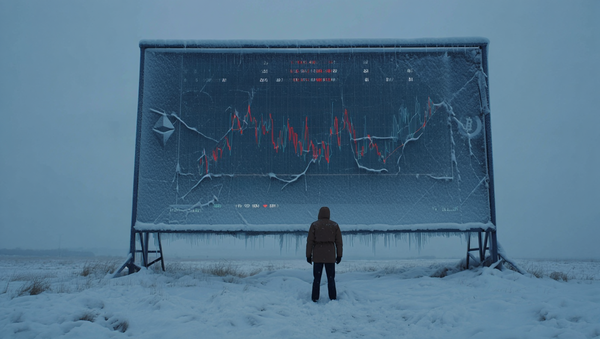
It is crypto winter again. Prices have been falling for six months, and more companies have shifted business direction or begun restructuring, including layoffs.
The regulatory environment is also challenging. Last year in the United States, the Genius Act, which includes institutionalising stablecoin rules, passed, raising expectations that regulatory uncertainty would ease significantly. But the Digital Asset Market Clarity Act, which would clarify the nature of crypto assets and the regulatory authority, faces an outlook in which passage in Congress is hard to be optimistic about.
On the price front, most major cryptocurrencies, including bitcoin, the bellwether of the crypto market, are falling.
Bitcoin has fallen by about half from its October peak last year of $126,080, The Information reported recently. Other cryptocurrencies have seen larger declines.
Trading volume, a key indicator reflecting interest in cryptocurrencies, is also continuing to shrink. Monthly crypto trading volume is heading toward its lowest level since January 2024, according to CoinGecko data. It has dropped to less than one-third of the level after the U.S. presidential election in November 2024.
The investment environment for crypto startups has also frozen. Investment in crypto startups in the first quarter fell 69 percent from the previous quarter, according to crypto advisory firm Architect Partners, The Information reported.
John D'Agostino (다고스티노), head of institutional strategy at Coinbase Institutional, said, "The current situation looks very dark." He added, "If market sentiment deteriorates this negatively, it could be a sign the market has bottomed."
The market for decentralised finance, or DeFi, services such as lending is also freezing. That includes DeFi lending, which is known to be relatively profitable.
For Aave, the largest DeFi lending protocol, the annualised reward for lending and borrowing Circle's USDC is 2.2 percent. That is sharply down from more than 6 percent on Nov. 1, 2025. Interest on Ethena's digital dollar USDe fell to 3.5 percent on March 30 local time from 5.5 percent in October. Given that risk-free short-term U.S. Treasury yields are around 4 percent, it is hard to see the benefits offered by DeFi services as attractive.
As market conditions worsen, there is talk that many crypto startups have shifted into survival mode.
The Information cited Button Labs, an early-stage startup that raised $5.1 million in funding last year, as an example. Button Labs changed its business direction from offering products that let bitcoin holders earn interest to selling AI-based tools for crypto trading. Button Labs' CEO said, "Waiting for the market to change is not the best choice," adding, "What many crypto startup founders are trying to do right now is simply survive."
In crypto winter, the industry is accelerating restructuring. Crypto exchange Gemini laid off 30 percent of its staff this year, and Crypto.com cut 12 percent of its staff in March.
Gemini founders Tyler and Cameron Winklevoss said the cuts were "measures to reduce costs and secure profitability." Gemini is also taking a conservative view of its business outlook. It expects trading volume over the next 2 years to fall short of 2025 levels, The Information reported.
Among crypto exchanges, a trend of expanding territory into prediction markets or traditional asset markets such as stocks and gold is also becoming more prominent. In the process, partnerships between traditional stock exchanges and crypto exchanges are also taking shape.
Intercontinental Exchange, the parent of the New York Stock Exchange, also invested in crypto exchange OKX. In the investment, OKX was valued at $25 billion. Nasdaq formed an alliance with Kraken to develop a tokenised stock market. Gemini is also facing a class-action lawsuit from investors after swiftly changing its post-listing business model to focus on prediction markets.
 Chi-gyu Hwang
delight@d-today.co.kr
Chi-gyu Hwang
delight@d-today.co.kr