
The government will step up its strategy to foster next-generation science and technology, including drawing up a comprehensive nanotechnology research plan every 5 years.
The National Science and Technology Advisory Council held its sixth deliberation meeting on April 27 in the council's main conference room, chaired by Vice Chair Lee Kyung-soo (이경수). It was the first deliberation meeting held since the launch of President Lee Jae-myung's first-term administration on Feb. 26.
The meeting reviewed and approved 2 agenda items, including the sixth nanotechnology master development plan for 2026 to 2035 and the direction for upgrading the national strategic technology framework.
The sixth nanotechnology master development plan is a comprehensive plan set up every 5 years to build a foundation for nanotechnology research and foster it systematically. It was jointly prepared by 14 ministries, including the Ministry of Science and ICT and the Ministry of Trade, Industry and Energy. Nanotechnology is a technology that creates new properties by manipulating and controlling materials of extremely small size.
Through the plan, the government presented strategies and 13 priority tasks to help South Korea become one of the world’s top 3 nanotechnology powers. It will pursue innovation in the nanotechnology industry through measures including global technology leadership through nano convergence, fostering the nano convergence industry, expanding nano convergence in the AI and quantum transformation, and creating a sustainable nanotechnology innovation ecosystem.
In particular, the government will support first-of-its-kind research in 5 major areas of nanoscience: sub-nano control, artificial nanomaterials, nano intelligence, nano transformation and nano-bio hybrids. This year it plans to select and support pilot projects within the nanomaterials technology development programme.
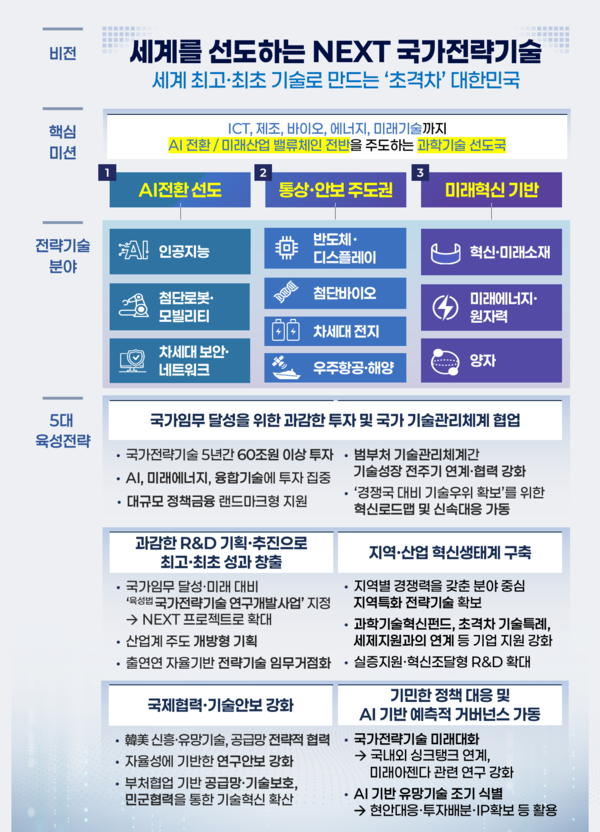
The government will also upgrade the national strategic technology framework. It strengthened links and convergence among technologies under 3 missions: leading the AI transition, taking initiative in trade and security, and building the foundation for future innovation. Based on this, it derived “NEXT national strategic technologies” spanning a total of 55 technologies.
It created a new “innovation and future materials” category in consideration of supply chain issues and AI-based research innovation. It expanded the existing energy technologies into a “future energy and nuclear power” category to reflect energy independence and rising power demand. It will also reinforce areas including upgraded AI infrastructure, blockchain, nuclear fusion, intelligent power grids, renewable energy, and carbon dioxide capture, utilisation and storage, or CCUS.
It newly included key defence and security technologies such as defence semiconductors, bio artificial organs and blood, brain-computer interfaces, reusable launch vehicles, drones, and eco-friendly autonomous ships. The government plans to invest 60 trillion won in national strategic technologies over the next 5 years and foster the full cycle, including securing foundational technologies, commercialisation, building industrial ecosystems and preventing technology leaks.
The meeting also received 3 agenda items, including the sixth national basic plan for standards for 2026 to 2030, a strategy to support and spread 10 promising carbon-neutral technologies, and the status of region-led science and technology innovation. The council will provide online live broadcasts of future advisory meetings, deliberation meetings and forums, including this deliberation meeting.
Lee Kyung-soo, vice chair of the National Science and Technology Advisory Council, said, "We will ensure that the deliberation meeting does not remain a formal procedure but functions as a venue for substantive policy discussions."
 Jin-ho Lee
jhlee26@d-today.co.kr
Jin-ho Lee
jhlee26@d-today.co.kr