
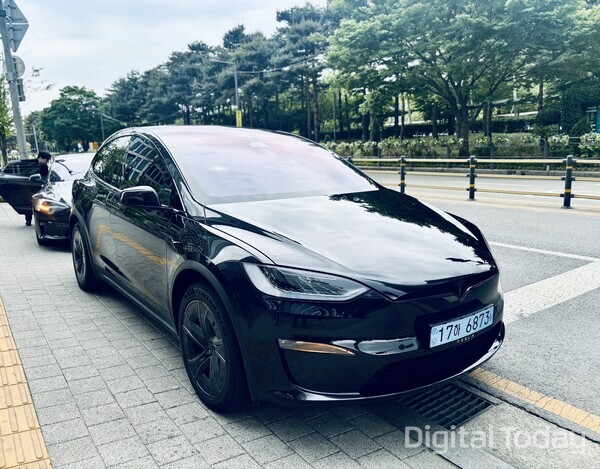
[DigitalToday reporter Seok Dae-geon] Socar is rapidly expanding the reach of its subscription business by putting Tesla Model X and Model S at the forefront. The two models, equipped with supervised Full Self-Driving (FSD), drew about 2,000 pre-bookings in 10 days. Demand is waiting despite prices of 1.49 million won a week and 3.99 million won a month. The result comes from directly targeting the previously empty 1 to 3-week market between short-term car sharing and monthly long-term rentals.
Socar on the 27th held a test-drive event for supervised FSD vehicles in the Seongsu area of Seoul. Vehicles deployed for the event were 2026 Model X and Model S units running the latest supervised FSD version (v14.1.4). Socar completed preliminary contracts to introduce the two models in the fourth quarter of last year and began taking pre-bookings in March this year. It has been delivering vehicles sequentially since mid-April to customers who signed final contracts.
Sitting in the driver’s seat, Park Jin-woo (박진우), a manager on Socar’s subscription business team who served as the guide, operated the screen. The test drive began in front of D Tower in Seongsu-dong, drove around the city area for about 25 minutes and returned to the same spot. Sitting in the driver’s seat, Park Jin-woo, a manager on Socar’s subscription business team who served as the guide, operated the screen.
After pressing the brake and holding down the center button, FSD was activated. The car judged traffic lights and lanes in Seongsu-dong on its own and entered toward Yeongdong Bridge. Lane changes, acceleration and deceleration were smooth even without holding the steering wheel. When a smartphone was briefly checked mid-ride, a warning sounded and the system paused. The car had to be pulled over and reactivated manually.
After pressing the brake and holding down the center button, FSD was activated. The car judged traffic lights and lanes in Seongsu-dong on its own and entered toward Yeongdong Bridge. Lane changes, acceleration and deceleration were smooth even without holding the steering wheel. When a smartphone was briefly checked mid-ride, a warning sounded and the system sometimes paused.
Even so, FSD worked very smoothly on the Gangbyeonbuk-ro riverside expressway. It worked to the point that there was no longer a need to worry about merging at the Seongsu and Seoul Forest entry section. An interview inside the car was conducted as the driver stepped back from driving. Park, in the passenger seat, explained the background to Socar’s subscription business.
During the test drive, Park said, "Socar’s short-term car sharing usually ends in a day to three days, or at most around a week," and added, "We have not been able to capture demand between that week and a monthly basis." That is the background to Socar’s renewal last month of its existing 'Socar Plan' into 'Socar Subscription' and cutting the minimum rental period to 1 week. After a week, it is automatically extended.
◆ Targeting the weekly market head-on... "Filling the gap between long-term and short-term"
The pricing structure was also redesigned for the weekly market. Subscription fees for the two models, including insurance, are 1.49 million won a week and 3.99 million won a month. There are no upfront costs such as acquisition tax. The contracted mileage is 400 km a week and 1,500 km a month. Park said, "If we calculate based on the value of the vehicle, we could charge more, but we set it low because we are at the stage of letting the market know," and added, "Tesla plays the role of a seed to promote the subscription service."
Another pillar of the shift to a subscription model is automatic renewal. Under the previous Socar Plan, customers had to choose whether to extend at each contract end date, but Socar Subscription continues unless there is a separate indication of intent. It is a funnel structure that pulls short-term car-sharing customers into weekly and monthly subscriptions. Park added, "The concept is to keep existing monthly customers while adding a new layer of weekly demand."
Supervised FSD vehicles sit at the very top of that funnel. In South Korea, the one-time purchase price of the supervised FSD option alone reaches 9 million won. The price of a vehicle including the option exceeds 150 million won. It is a price range that is difficult for ordinary consumers to experience easily. All 100 vehicles introduced by Socar are one-time purchases with FSD tied to the vehicles. With Tesla CEO Elon Musk having said FSD will be provided only as a monthly subscription in the future, the asset value of the pre-secured units increases over time.
New orders for the Model X and Model S in South Korea have already ended. Tesla announced it would halt production of the two models in the second quarter, and that is why Socar became the only large rental operator to hold supervised FSD Teslas. Some long-term rental car companies handle Tesla, but most are in the form of 1 to 2-year leases.
◆ CEO Jae-wook Park bets on autonomous driving data
On the surface, this test-drive event is about promoting Socar Subscription and Tesla FSD, but beneath it lies a bigger picture: an autonomous driving data business. Socar CEO Jae-wook Park (박재욱) has been focusing on a new autonomous driving business since the first quarter of this year. A Socar official said, "CEO Park currently only looks at new businesses in the Future Mobility task force (TF)," and added, "The first thing the TF did in the first quarter was to build a pipeline of driving data accumulated so far."
Socar highlights its data-collection structure as its competitiveness. Its 25,000 vehicles nationwide are equipped with two-channel front and rear black boxes and its own telematics device (STS). STS transmits in real time to headquarters more than 100 vehicle data points, including speed, steering, brakes and acceleration. The daily driving distance of these vehicles is 1.1 million km, which is 10 times the total length of roads nationwide of 110,000 km. Socar has also completed a full-sensor-kit prototype equipped with LiDAR, 7 cameras and an inertial measurement unit (GPS IMU), and plans to expand it step by step to up to 1,000 vehicles.
According to Socar, training an end-to-end (E2E) autonomous driving model requires three things: a large fleet, vehicle data-collection capability and a centralised pipeline. The company says only Tesla and Socar have all of them in the global market. Automakers have fleets but no pipeline, while autonomous driving startups operate only dozens of vehicles.
Accident data is the hardest asset to secure. Socar stores more than 40,000 cases a year of real accident footage and egomotion data, and it holds a cumulative 220,000 cases (8.8TB). It is edge-case data that is difficult to reproduce through simulation. This is the point where the subscription business fronted by Tesla and the autonomous driving data business behind it meet.
A Socar official said, "In the autonomous driving era, many AI models are already open, so what ultimately determines service quality is what data you train on," and added, "Driving data accumulated over 15 years for Socar to survive as a short-term car-sharing operator has now been reborn as data with value."
 Seok Dae-geon
d2dg@d-today.co.kr
Seok Dae-geon
d2dg@d-today.co.kr