
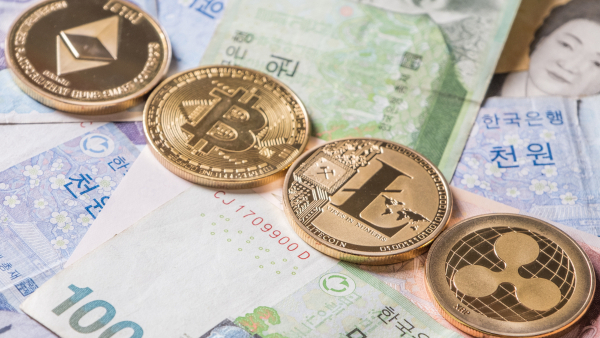
South Korea's digital asset market capitalisation stood at 87.2 trillion won at end-2025, down 8 percent from 95.1 trillion won at end-June that year. Average daily trading in the second half was 5.4 trillion won, down 15 percent from 6.4 trillion won in the first half.
• South Korea's digital asset market cap falls to 87 trillion won... era of 10 million users opens • People Power Party accelerates push to scrap digital asset income tax... "Ready to discuss even today"
The number of digital asset user accounts through domestic exchanges rose 3 percent to 11.13 million from 10.77 million at end-June. Users' won-denominated deposits increased 31 percent to 8.1 trillion won from 6.2 trillion won over the same period.
The People Power Party, the opposition party, is speeding up efforts to pursue related legislation after officially adopting the abolition of a digital asset income tax as party policy. The party pledged on March 25 to completely scrap the imposition of the digital asset income tax from next year, through an on-site meeting on improving the digital asset taxation system. With taxation on digital asset investment income scheduled from Jan. 1, 2027, under the government and the ruling party, the People Power Party says it will abolish it.
Market views on XRP are sharply divided. Amid rosy forecasts of a 7,800 percent surge and YouTubers urging all-in bets, trading volume is falling and even Ripple's CTO is pushing back against excessive market expectations.
• "XRP will rise 7,800 percent like Cardano in 2021"... investors split • Ripple CTO: "XRP at $100? If you really believed it, it would have already risen... same for bitcoin"
An analysis has emerged saying XRP could follow the path of Cardano (ADA), which recorded an explosive rise in 2021, and surge as much as 7,800 percent. The bullish view, citing a fractal pattern based on past charts, is fueling expectations among investors, but opposing views pointing to limits on gains are also holding firm.
Ripple's chief technology officer David Schwartz (데이비드 슈워츠) also poured cold water on a blind "XRP to $100" narrative. He said that if market participants truly believed in that price, it would have already surged as it would have been priced in, adding that the value of all assets, including bitcoin, is based on the public's actual trust.
• XRP's downtrend is over?... Analyst: "The real rise starts now" • Grayscale: "XRP leads portfolio diversification beyond bitcoin and ethereum"
Some also argue that XRP, which had suffered in a long downward channel, has finally ended its downtrend and shifted to an uptrend. Global asset manager Grayscale has pointed to XRP as a key alternative to diversify institutional investors' portfolios that are concentrated in bitcoin and ethereum. The analysis says XRP's value as an institutional portfolio asset is being reassessed beyond a simple payment tool, and that it could become a strong channel for an inflow of institutional money.
A strange phenomenon has occurred in which gold prices, a traditional safe-haven asset, plunged the most in 43 years amid a geopolitical crisis described as a war with Iran. Bitcoin, by contrast, is controlling volatility led by institutional funds and building a new order, while wallets from the Satoshi era that had been dormant for more than 10 years are waking up in succession, unsettling the market.
• Bitcoin will no longer see a major crash... "A completely different market led by institutions" • Gold prices fall during war with Iran... biggest drop in 43 years • Bitcoin enters battle to hold $70,000... volatility in oil and stocks widens
A view is emerging that the halving-type crashes that frequently occurred in a speculative arena dominated by retail investors will now be hard to find. It says the market's structure has completely changed as Wall Street institutions manage massive funds, and a thick capital support line is absorbing extreme volatility.
With geopolitical jitters in the Middle East rising, gold prices, once called an eternal refuge, instead plunged by the most in 43 years. As gold failed to play its role even in the face of economic shocks, it is seen as a shocking signal that macroeconomic trends are swinging sharply.
As international oil prices move uneasily and volatility in global stock markets expands, bitcoin has entered an intense battle to hold the $70,000 level. It could become a foothold for a new rally if it defends the support line while fending off macro headwinds, but the key is whether it can withstand broader pressure coupled with a surge in oil prices.
The U.S. crypto bill known as the Clarity Act, which had been stalled, is being shaken ahead of a May deadline. In the meantime, Wall Street is quietly absorbing the coin ecosystem by tokenising Nasdaq stocks and taking control of stablecoin infrastructure.
• Is the Clarity Act becoming useless?... U.S. SEC-CFTC guidelines rise • U.S. SEC approves tokenisation of Nasdaq stocks... Wall Street leads blockchain • U.S. Congress reaches deal on stablecoin interest issue... crypto bills gain momentum
As the Clarity Act, a basic virtual asset law in the U.S. Congress, remains stalled due to political confrontation, guidelines issued independently by regulators such as the SEC and the CFTC are emerging as new market rules. Concerns are being raised that the bill itself could become useless as administrative measures fill the gap created by legislative delays.
The conservative U.S. SEC has officially approved issuing blockchain-based tokenised versions of stocks listed on Nasdaq, breaking down the wall between traditional finance and virtual assets. It is akin to an explicit declaration that Wall Street's big capital will fully take control of the Web3 ecosystem under the banner of stock tokenisation.
The U.S. Congress has also finally reached common ground on the long-standing issue of allowing interest payments to stablecoin holders. This has renewed momentum in discussions on comprehensive crypto regulation bills that had been deadlocked, laying the groundwork for legislation to move quickly.
The crypto market ecosystem is also being reshaped at a daunting pace. Binance is delisting altcoins that have lost competitiveness in bulk, and Solana's top figure has declared the end of blockchain games. AI bots are rapidly replacing human traders.
• AI leads crypto futures markets... manual trading disappears • Binance decides to delist 8 altcoins... immediate plunge • Solana Foundation head: "Blockchain games are over"
Binance, the world's largest exchange, has decided to delist eight altcoins that have lost competitiveness. The coins fell sharply immediately after the announcement, signalling that exchanges have begun a ruthless sorting of coins whose use cases are not clear.
The head of the Solana Foundation, which backs the high-performance blockchain Solana, publicly declared the failure of existing blockchain game models. He stressed that luring users with forced coin rewards has run its course, effectively pronouncing a death sentence and saying the market paradigm must move to a new stage.
In the crypto futures market, where prices fluctuate by the second, manual trading that depends on human emotion and judgement is rapidly disappearing. AI algorithm bots that learn vast data in real time and execute trades mechanically are dominating the market and changing the trading paradigm.
 Hyunwoo Choo
cookinpapa@d-today.co.kr
Hyunwoo Choo
cookinpapa@d-today.co.kr