
People Power Party has formalised as party policy a plan to abolish a digital asset income tax and has begun pushing related legislation.
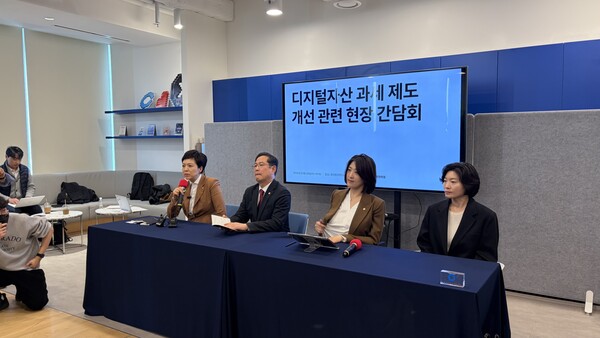
The party on March 25 held an on-site meeting on improving the digital asset taxation system at Coinone's headquarters in Yeongdeungpo, Seoul. The event was attended by People Power Party floor leader Song Eon-seok, the party's chief policy spokesman in the parliamentary floor leadership Kim Eun-hye (김은혜), lawmakers Park Soo-young (박수영) and Choi Bo-yoon (최보윤), and representatives of the five major digital asset exchanges Upbit, Bithumb, Coinone, Korbit and Gopax.
The key agenda item was a complete rollback of the digital asset income tax, which is approaching next year. With the government and ruling party planning to levy tax on digital asset investment income from Jan. 1, 2027, the opposition People Power Party says it will abolish it.
Song on March 19 submitted a bill to partially amend the Income Tax Act to abolish a digital asset income tax on income arising from digital asset transfers and lending.
FINANCIAL INVESTMENT TAX SCRAPPED, BUT DOUBLE TAXATION ROW
Kim Eun-hye detailed what she called the logical contradictions in imposing a digital asset income tax.
Kim said young people investing in digital assets are strongly asking why stocks had their financial investment tax scrapped but digital assets are still subject to income tax. She said if the government classifies digital assets as products, then imposing income tax in addition to exchange fees that already include value-added tax is clear double taxation.
Under current law, profits from trading digital assets are classified as other income, making loss carryforwards impossible. That stands in stark contrast to stock trading gains, which are classified as financial investment income and allow loss carryforwards.
Kim criticised this and said to correct the dual view of the market and impose income tax, the government must first clarify its understanding of the new digital asset market and define the concept clearly to be seen as reasonable and fair by the public.
She also cited recent international trends.
Kim said the U.S. Securities and Exchange Commission (SEC) regards digital assets as products rather than securities, so imposing income tax is not appropriate. She said young people are taxpayers and investors who pay taxes, and the approach should not rely on a uniform view that forced regulation of the market under 1980s banking law.
NATIONAL TAX SERVICE LACKS PRACTICAL CAPACITY, NOT READY TO IMPOSE INCOME TAX
The tax authority’s lack of readiness in administrative systems was also criticised. Park Soo-young said the National Tax Service lacks understanding of digital assets and has very limited preparation and capacity to impose income tax, and that its practical response capability is low as seen in a past mnemonic code exposure incident.
Park in particular pointed to limits in international tax standards and domestic infrastructure.
He said even if the OECD’s Crypto-Asset Reporting Framework (CARF), which it is pushing, is introduced from 2027, only total transaction volume data would be exchanged between countries and detailed personal information would not be provided, making taxation quite difficult. That means effective tax tracking would be impossible.
The National Tax Service’s limited scope for collecting transaction information domestically was also cited as a fatal weakness for taxation. Its system is currently linked only to information from the five major won-based exchanges such as Upbit.
Park warned that if only the five exchanges are controlled, a balloon effect could occur as assets flow en masse to overseas exchanges or other small and mid-sized domestic exchanges to avoid paying tax.
He added that considering all current circumstances, imposing a digital asset income tax from January 2027 is a very dangerous idea that is completely unprepared.
Choi Bo-yoon also shared concerns about capital outflows. Choi said even now, digital assets are moving to overseas exchanges due to tax issues or regulation, and that the taxation system should be comprehensively reconsidered in full, taking all such factors into account.
ABOLISHING INCOME TAX WOULD HELP YOUNG PEOPLE BUILD WEALTH
People Power Party said improving the digital asset taxation system goes beyond a simple tax benefit and would restore a ladder for wealth formation for the younger generation.
Asked about the upcoming local elections and the youth vote, Park said surging real estate prices have made it very difficult for young people to build assets. He said abolishing the digital asset income tax would be a big help for young people’s wealth formation.
He drew a line on concerns about excessive funds concentrating in the digital asset market.
Park said it cannot be said that funds will necessarily flow only into digital assets, noting that under the current government stock prices have also risen and the KOSPI has not looked toward the 6,000 level. He said the goal is not to make people pay no tax at all, but to prevent double taxation by adding income tax on top of value-added tax that is already being paid.
PHASE 2 LEGISLATION, IMMEDIATE PERMISSION FOR INSTITUTIONS TO ENTER
Along with the debate on abolishing income tax, talks on phase 2 legislation were also given significant weight. People Power Party has strongly pushed to foster the digital asset industry since its presidential election pledges.
Choi said it is a time when it is very necessary to vitalise the digital asset market with a focus on fostering, moving away from what she described as the ruling party’s one-sided regulatory stance. With the United States already declaring it would view digital assets as products, she said legislation aligned with global standards is urgent.
Choi in particular called for immediately allowing institutions, corporate investors and foreign investors to enter the market. The domestic market currently has corporate and foreign investment blocked, leaving an isolated structure centred on individual investors.
Choi said delays in phase 2 legislation have also halted discussion on activating corporate and foreign investors. She urged swift discussions on ways to allow market participation by integrating global market trends, investor protection and exchanges’ practical demands.
The opposition party also urged a change in attitude from the ruling Democratic Party.
Kim said People Power Party wants to start discussions immediately, even today, on phase 2 legislation and taxation issues, but the Democratic Party has not presented a unified agreed bill or specific views. She criticised the party, saying it is urgent for the ruling party and government to first sort out a clear position.
Park also said he hopes the ruling party will set a clear position by the time the abolition bill submitted by Song is discussed in the tax subcommittee. He said People Power Party may be the minority party, but it will fight to the end to represent the interests of digital asset investors and the younger generation.
 Oh Sang-yup
yub@d-today.co.kr
Oh Sang-yup
yub@d-today.co.kr