
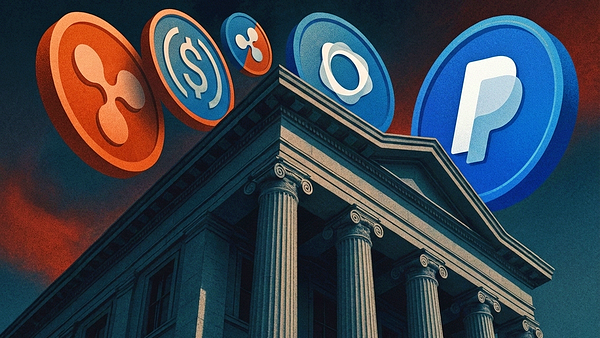
[DigitalToday reporter Hyunwoo Chu] The digital asset market in 2025 accelerated its rise as institutionalisation, led by the United States, gathered pace. Stablecoin enthusiasm in particular shook markets at home and abroad. As industry moves continued to use stablecoins in real-world financial markets beyond cryptocurrencies, stablecoins quickly emerged as a major issue across digital finance.
• [2025 Wrap-up 11/Digital assets] Institutionalisation gains pace... Stablecoin enthusiasm heats up • [2026 Outlook] Digital payments market to undergo major change led by 'AI·stablecoins'
With the start of 2026, the global digital payments market is entering a phase of structural transition rather than gradual technological change. Payments no longer mean a simple act of paying. They are being reshaped into a core operating layer where financial regulation, technology infrastructure and industrial strategy mesh at the same time. The shift is likely to centre on stablecoins entering the regulated system, the spread of AI agent-based automated payments and the practical use of onchain payment and settlement infrastructure. The industry views this point as a turning point from technology validation to commercialisation.
• Corporate virtual asset market unlocks... Finance and exchanges step up 'blood alliance'
As the opening of the corporate digital asset market becomes more visible, cooperation between domestic exchanges and the financial sector is being reshaped quickly. It is evolving from subordinate partnerships for issuing real-name accounts into horizontal alliances that share wealth management, foreign remittances and custody infrastructure.
Heading into 2026, the hottest topic is Ripple's XRP. The market is split between expectations that XRP will deliver explosive growth and warnings that it is an arena individual investors cannot bear. In particular, analysis suggests XRP may not be suitable for typical retail investing because it is designed as a 'financial infrastructure' rather than a simple coin. Its nature as a bridge currency for large inter-institution payments means it is more likely to move in a long-term, heavy way than deliver the short-term price gains sought by small investors.
• XRP is not a coin for individual investors... Prices will be hard to bear • "20,000 XRP cannot deliver financial freedom... even if it goes from $2 to $100"
Debate among investors over the standard for 'graduation' is also stark. The calculation is that even if XRP surges to $100, holding about 20,000 units would make it difficult to achieve true economic freedom once inflation is considered. Some also stress scarcity. The scenario is that if XRP is fully adopted in the future financial system, 99 percent of the world's population will not be able to hold even 1 unit, triggering a 'supply shock'. For this reason, experts advise that at least 1,000 units are needed to seize future opportunities.
• "99 percent of the world's population will not be able to hold even 1 XRP" shocks • Standard Chartered sees XRP at $8 in 2026... Regulatory clarity is key
The view from the regulated system is positive. Standard Chartered predicted that if regulatory clarity is secured, reaching $8 by 2026 would be possible, and some cite past silver surge patterns to mention the possibility of a 3,900 percent jump. It also comes with sharp warnings that investors should not ignore onchain data red flags such as whale exits and a decline in network activity. Bitwise's CIO offered the insight that after the end of the bitcoin four-year cycle theory, attention should turn to XRP, which has strong utility, as the next candidate.
The bitcoin market in 2026 is expected to be the first year when the existing formula breaks. Instead of a mechanical rise driven by halving, it is shifting to a structure where macroeconomics and the movement of big capital determine prices. Wall Street research firm Bernstein assessed that there may not be a blowout rally like the past, but spot ETFs and institutional inflows are reducing volatility and moving it into a stage as a 'stable asset' with a steady upward trend.
• "The four-year cycle is over, but..." Bernstein's bitcoin outlook for 2026 • Bitcoin at $150,000 in 2026... Only Ethereum and Solana survive among alts
Price forecasts are polarised. Some push optimism that it will jump to $150,000 in 2026 and as high as $250,000, while fear-tinged forecasts persist that it could plunge to $10,000 due to tighter regulation and technological limits. In the meantime, a big shift of Asia-based funds is a variable worth watching. Analysis says wealthy Chinese are beginning to prefer bitcoin over real estate, and that this could become a powerful catalyst for a 2026 bull market. Technical analysis is also gaining traction that the current gold and silver rally is similar to the period just before bitcoin's 2020 surge.
• $250,000 vs $10,000... Polarised bitcoin outlook for 2026 • Is bitcoin next after the gold and silver rally?... Similar to the 2020 surge market
For the altcoin market, 2026 could truly become a 'graveyard'. The warning is that, as in the dot-com bubble collapse, projects without clear profit models or real-world use cases will see their value converge toward zero and be cleared out. Even if the era of $150,000 bitcoin arrives, polarisation is expected to deepen, with only a very small number such as Ethereum and Solana surviving among altcoins.
• "Most altcoins will not survive in 2026"... Which coins will remain? • Charles Hoskinson: "Crypto will grow explosively within 10 years... RWA is key"
Niche markets are also expected to advance. Meme coin leader Shiba Inu is strengthening its ecosystem, 'Shibarium', and its burn mechanism, laying out a scenario of a 1,150 percent surge in 2026. Bull Tom Lee predicted that Ethereum, the centre of DeFi and NFTs, will ultimately overtake bitcoin, while Solana is consolidating its position by breaking through resistance lines with fast speed and low fees. Cardano founder Charles Hoskinson presented a vision that tokenisation of real-world assets such as real estate and stocks, known as RWA, will be key to growth over the next 10 years.
The scene on the market's fringes is also unusual. The fact that Warren Buffett, known as an investing master, is holding cash at a record-high level suggests a peak in traditional markets, drawing attention to the possibility that this huge pool of money could flow into digital assets. In South Korea, regulators are tightening the reins, including the FIU imposing a hefty administrative fine on Korbit, and exchanges are expected to face a tougher fight for survival.
• Berkshire without Buffett holds cash at a record high... Where next? • Will stablecoins spark a payments revolution?... Key outlooks for 2026 • Bought more than Google... Korean retail investors buy 'Bitmine' after an 80 percent plunge
In the payments market, stablecoins are expected to rise into the mainstream and threaten existing financial networks, while Korean retail investors are continuing high-risk investing by buying large amounts of the mining stock 'Bitmine' after a plunge. The crypto market is also showing signs of becoming closely intertwined with political power, including speculation that a hacking criminal could be released early due to political change, described as the effect of Donald Trump's election.
• South Korean crypto investors are big players... Sent 158 trillion won to overseas exchanges in 2025
South Korean crypto investors were found to have transferred more than 158 trillion won to overseas exchanges in 2025. A key reason was that, due to regulation at domestic exchanges, investors moved to overseas platforms that offer more options.
 Hyunwoo Chu
cookinpapa@d-today.co.kr
Hyunwoo Chu
cookinpapa@d-today.co.kr