
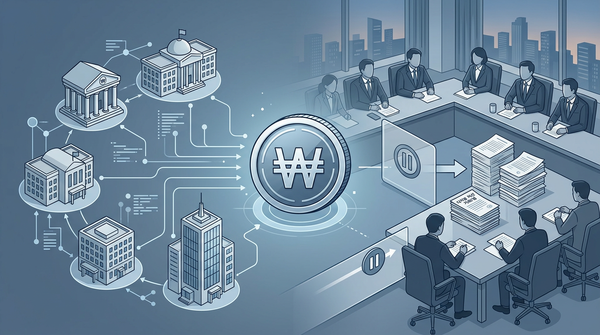
Talks on enacting the Digital Assets Framework Act have entered final coordination. Disagreements persist among political circles, financial authorities and the industry over the key issue of limits on major shareholders’ stakes in digital asset exchanges.
The Democratic Party’s digital assets task force and the Financial Services Commission prepared a compromise to broaden stablecoin issuers beyond banks to include fintech firms and others. But they excluded the Digital Assets Framework Act from the agenda of the party-government consultative meeting set for March 19.
• Door widened for stablecoin issuance, but Digital Assets Framework Act talks delayed again • Will the Digital Assets Framework Act come out this month? Major shareholder stake limits still a sticking point
With stock market jitters growing due to worsening Middle East tensions, the meeting schedule was pushed back. The bill has since slipped down the list of priorities. Given the government had presented a stablecoin regulatory framework as a key task for the first quarter, there are expectations that the March legislative target has inevitably been disrupted.
• FSC imposes 6-month business suspension on Bithumb and 36.8 billion won fine • 'Largest-ever fine' for Bithumb... "We respect the authorities’ decision... we will improve the cited issues"
Financial authorities imposed a six-month partial business suspension and a 36.8 billion won administrative fine on digital asset exchange Bithumb for alleged violations of the Act on Reporting and Using Specified Financial Transaction Information, including breaches of anti-money laundering obligations. They also decided personnel sanctions on executives, including a disciplinary warning for the chief executive and a six-month suspension for a reporting officer. Bithumb said in a statement, "We respect the financial authorities’ sanctions decision and will improve the cited issues to do our utmost to protect users."
• As Upbit and Bithumb slow, Binance expands derivatives in South Korea
As trading volumes at domestic digital asset exchanges such as Upbit and Bithumb have slowed, attention is on global exchange Binance as it expands products targeting the South Korean market, including ETF-linked perpetual futures.
Last year, Upbit and Bithumb ranked first and second in South Korea by monthly active users, while Coinone and Binance vied for third. Binance’s monthly active users in South Korea were tallied at about 300,000 to 400,000, similar to Coinone. As domestic exchanges face declining volumes and tighter regulation, overseas exchanges are absorbing domestic investment demand by emphasizing product variety and derivatives competitiveness.
In March, the cryptocurrency market is showing a sense of tension, with geopolitical crises intersecting with technological innovation. Amid the specter of war in the Middle East, bitcoin rose past $74,000 and has rapidly emerged as a refuge, and is emerging as an ultimate safe asset to replace gold. As institutional inflows into spot ETFs continue, conservative views also coexist, with some still deriding it as a "Ponzi scam."
• Trump forms Hormuz coalition... bitcoin breaks $74,000 • Middle East war fallout could be positive for bitcoin... some estimate up to $250,000 • "Gold is no longer a safe asset... 2008 financial crisis could recur"
Each time global political and economic uncertainty reaches an extreme, the phenomenon of capital fleeing into decentralized bitcoin rather than fiat currencies or traditional assets has again been clearly demonstrated. It shows its status as a store of value even in the face of the worst risk of war.
An analysis of the impact of geopolitical crises on bitcoin offered an unusual forecast that the fallout from the Middle East war could instead concentrate liquidity into bitcoin and push it as high as $250,000. It is a macro analysis that the more inflation-hedging demand combines with rising economic anxiety, the more bitcoin’s appeal as a censorship-resistant asset is maximized.
It is a provocative diagnosis that gold, which has long reigned as the quintessential safe asset for thousands of years, can no longer serve as a perfect haven as it once did. It warns that amid shifts in the global economic structure and concerns about systemic collapse comparable to the 2008 financial crisis, smart money is accelerating its move into digital assets that provide immediate liquidity across borders and regulations rather than heavy, inconvenient physical gold.
• Former British Prime Minister Boris Johnson takes aim: "Bitcoin is a 'Ponzi scam'"
By contrast, former British Prime Minister Boris Johnson (보리스 존슨) strongly criticised bitcoin as a "Ponzi scam" with no intrinsic value, representing conservative views within the establishment. It is a symbolic remark showing that even as bitcoin breaks past prior peaks and is being incorporated into institutional finance, deep-rooted distrust and resistance remain among traditional politicians and figures from older generations of finance who refuse to recognise cryptocurrency itself.
Market expectations around XRP are nearing a breaking point. As a six-year-long consolidation and re-accumulation pattern nears its end, chart analyses are pouring out that a surge of thousands of percent is imminent. Along with an institution’s assessment that it will establish itself as a $150 trillion global payments infrastructure beyond a simple coin, analysis that even stablecoins cannot replace XRP’s ultra-liquidity role is adding force to bullish views.
• XRP re-accumulation pattern for 6 years... price targets for 2026, 2028 and 2031 • XRP targets $150 trillion payments market... Evernode says "It will be core infrastructure" • Why stablecoins cannot replace XRP... "Exclusive role in securing global liquidity"
A technical analysis says XRP has formed a re-accumulation pattern over the past 6 years, building up massive energy, and that the time for an explosion is now near. It presents step-by-step price targets for 2026, 2028 and 2031 over the long term, suggesting investors with long patience could be rewarded. It stresses that the dull sideways market was a process of laying a solid foundation for an explosive rally, offering a rationale for long-term holding.
Global blockchain firm Evernode said Ripple (XRP) is core infrastructure that will dominate a huge $150 trillion global cross-border payments market, beyond being a simple virtual asset. It shows strong conviction that with unmatched speed and scalability capable of replacing slow and expensive traditional financial networks, financial institutions worldwide will have no choice but to adopt XRP as an essential liquidity tool.
A deeper analysis says that while the stablecoin market has recently grown rapidly, it cannot replace XRP’s essential role as a bridge currency. While stablecoins are pegged to the currency of a specific country and therefore have limits in issuance and regulation, XRP provides "ultra-liquidity" that can be instantly exchanged into any currency, and will therefore maintain an exclusive position in global remittance networks.
• Circle’s USDC overtakes Tether’s USDT by actual transaction volume... landscape shifts after 6 years • Circle launches nano-payment testnet... tiny USDC payments
Circle’s USDC, long the perennial number two in the stablecoin market, produced a major upset by overtaking long-time leader Tether (USDT) in on-chain transaction volume for the first time in 6 years. It means institutional investors and the DeFi ecosystem have started to prefer USDC, which is more transparent and strictly compliant with regulation, over USDT, which often faces controversy over opacity. Stablecoin market hegemony is being rapidly reshaped around "trust" and "regulatory compliance."
Circle launched a testnet designed to process nano-payments worth just tens of won in real time without fee burdens. It is a core technology that could open a new micro-economy ecosystem, enabling per-content payments and automated system-to-system payments that were not possible through existing credit card or banking networks.
• [Tech Insight] "Mass adoption comes when people use stablecoins without knowing they are stablecoins"
It offers a technical insight that true mass adoption of crypto assets is only completed when systems are integrated so seamlessly that users do not even recognise they are using blockchain technology or stablecoins. It forecasts that the "hidden infrastructure" of stablecoins such as USDC invisibly handling payments and remittances behind fintech apps will become a key trend in the payments market in 2026.
• Where did the dream of 'ultra-sound money' go... Ethereum suffers a complete defeat to bitcoin after proof-of-stake • "Alt season is over"... era of short cycles and violent rotation is coming
An analysis says that after Ethereum’s ambitious shift to proof-of-stake, its dream of "ultra-sound money" through deflation has effectively collapsed and it is being soundly defeated in its value competition with bitcoin. It says network upgrades have instead caused inflation, and liquidity fragmentation has made it lose appeal as the leading altcoin. It shows structural limits in the Ethereum ecosystem and a deepening bitcoin concentration.
It warns that the traditional "alt season" in which all altcoins surged together is over forever, and an era of "violent rotation" has arrived in which capital rapidly concentrates in specific themes or meme coins and then exits within an extremely short time. It says that in a polarised market where institutional money focuses only on bitcoin and a small number of major assets, retail investors’ vague hold-on strategy no longer works.
 Hyunwoo Chu
cookinpapa@d-today.co.kr
Hyunwoo Chu
cookinpapa@d-today.co.kr