
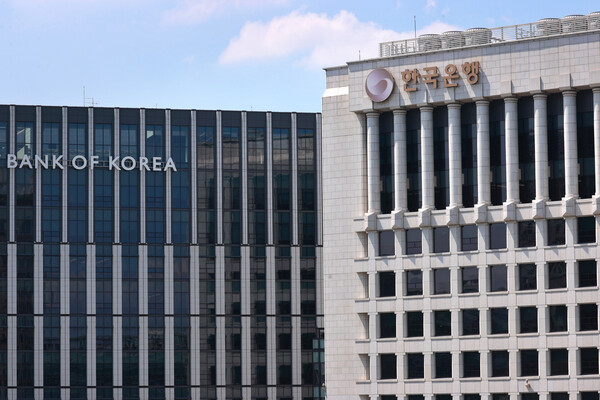
The Bank of Korea is formally launching phase two of Project Hangang to build next-generation payment and settlement infrastructure based on a wholesale central bank digital currency and deposit tokens. The focus is on checking the feasibility of formally adopting the digital currency system and laying the groundwork for commercialising deposit tokens.
The Bank of Korea said on Tuesday it will 추진 phase two (Phase II) of Project Hangang to expand the scope of payment and settlement systems using digital currency and deposit tokens and to develop innovative services.
Project Hangang aims to build a digital currency infrastructure in which the Bank of Korea and participating banks issue and circulate a wholesale digital currency and deposit tokens, respectively. It targets lower-fee payment instruments than existing options and innovative payment services using programming functions such as smart contracts.
In phase one, which ran from October 2023 to August last year, the Bank of Korea verified whether the digital currency and deposit tokens functioned properly across the full process of manufacturing, issuance, circulation, redemption and disposal. During that process, it built a blockchain-based digital currency system and carried out related institutional and technical preparations in parallel.
In a real-transaction pilot conducted from April to June last year based on that work, a total of 81,000 people participated, based on digital wallets. The total number of transactions reached 114,880. The transactions included payments at merchant locations and conversions between deposits and deposit tokens.
Phase two will expand participating banks and merchant locations. In addition to the seven banks that took part in the real-transaction pilot — KB Kookmin Bank, Shinhan Bank, Woori Bank, Hana Bank, IBK Industrial Bank of Korea, NH Nonghyup Bank and Busan Bank — BNK Kyongnam Bank and iM Bank have expressed an intention to join, bringing the total to nine banks.
Participating banks plan to secure a range of payment locations, including small business owners as well as large companies, as they focus on fee-saving effects for deposit token payments.
Service convenience will also improve. A person-to-person remittance function will be newly introduced, along with biometric-authentication access and automatic deposit token deposits and withdrawals. Users will be able to use the service through biometric authentication such as fingerprints instead of entering a password, and if there is a shortfall at payment, deposits will automatically be converted into deposit tokens.
Phase two is also set to expand cases applying digital vouchers using programming functions. In phase one, three digital vouchers were issued: the Seoul Youth Culture Pass, a scholarship at Silla University in Busan and a library voucher in Daegu.
The technology is also expected to be applied to a project to build electric vehicle charging facilities, which is being promoted as part of a government pilot project for blockchain-based execution of national treasury funds. The plan is to verify the feasibility of public finance execution methods using digital currency and deposit tokens.
The Bank of Korea will also continue research into the possibility that digital currency and deposit tokens could be used in the future as payment instruments for artificial intelligence-based services and digital asset transactions. In December last year, it verified the possibility of using deposit tokens as a payment instrument in an AI agent service in which AI searches for products and completes purchases.
It also plans to continue researching ways to use deposit tokens in digital asset transactions such as tokenised bonds and stocks.
The Bank of Korea plans to review the possibility of commercialising the digital currency infrastructure through the phase two project. To that end, it will also pursue consulting by external specialised institutions to comprehensively review tasks for institutional improvement and measures to operate and upgrade the system.
The Bank of Korea said, "Through Project Hangang, we plan to establish stable and efficient digital currency and deposit tokens in the market, provide a low-cost universal payment instrument, and implement innovative financial services that can be programmed." It added, "We will support the development of the domestic digital asset ecosystem and reliably underpin the digital transformation of the payment and settlement system."
 Ji-young Lee
ljy@d-today.co.kr
Ji-young Lee
ljy@d-today.co.kr