
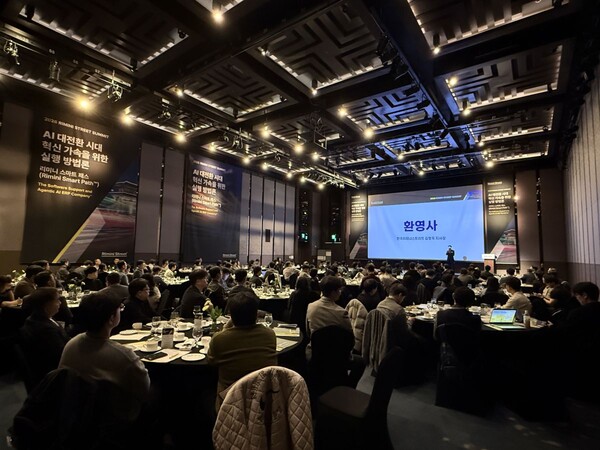
Rimini Street, a company providing enterprise software support and innovation solutions, held its annual 2026 Rimini Street Summit on March 12 at the Grand InterContinental Seoul Parnas in Seoul.
In a welcome address, Kim Hyeong-uk (김형욱), country manager at Rimini Street Korea, said, “AI is no longer a future technology but a current source of competitiveness.” He said the key is not adopting technology but how to execute it and build a sustainable innovation structure. He said Rimini Street has supported about 200 organisations in South Korea and more than 6,300 enterprises and public institutions worldwide, helping customers save more than $10 billion in IT costs. He said a core value is supporting customers so they can reinvest saved budgets in AI-based innovation rather than simply reducing costs.
Eric Helmer, global CTO at Rimini Street, said in a keynote speech titled “Accelerate your Smart Path to Agentic AI ERP” that ERP is evolving from a system of record into an intelligent execution platform. He said future ERP will not be a system that stores data, but an agentic AI ERP system that understands goals and performs tasks on its own.
In a presentation titled “Achieving SAP ERP innovation through agentic AI ERP,” Lee Yong-haeng (이용행), an executive director at Rimini Street Korea, said companies running SAP environments face the burden of upgrades and maintenance costs. He said they must find ways to enable AI-based automation and process optimisation while keeping their existing ERP. He said applying agentic AI, unlike generative AI that simply creates reports, can directly carry out repetitive tasks such as order processing, approval processes and inventory management. He said this can improve transaction accuracy and processing speed at the same time.
Kim Hyun-ho (김현호), an executive director at Rimini Street Korea, gave a detailed explanation of how to implement Rimini Smart Path, a tailored maintenance optimisation solution, under the theme “Securing funds for innovation and executing IT infrastructure operations optimisation.”
He said many companies agree on the need for AI innovation but lack the budgets and staff to carry it out. He said a practical starting point is to structurally cut existing maintenance costs to secure funding for innovation. He said Rimini Smart Path is based on a three-stage model of Support, Optimize and Innovate. He said it helps customers maximise the value of existing software assets while gaining strategic flexibility by breaking away from vendor-mandated high-cost upgrade cycles.
Kim Dae-hyun (김대현), a managing director at Rimini Street Korea, stressed that a strategic approach is needed to respond to changes in VMware vendor policies. He said companies need flexibility across their IT infrastructure, reduce dependence on a single vendor and secure choice to build competitiveness for sustainable business.
 Hwang Chi-gyu
delight@d-today.co.kr
Hwang Chi-gyu
delight@d-today.co.kr