
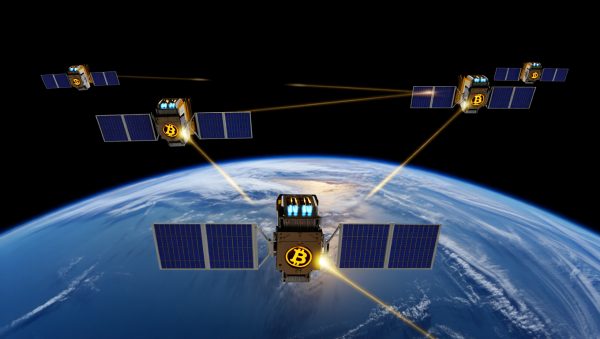
A bid is under way to mine bitcoin (BTC) in space using satellites for the first time in human history.
On March 9 local time, blockchain media outlet Cointelegraph reported that space technology and artificial intelligence (AI) infrastructure company Starcloud announced a plan to begin bitcoin mining from satellites. The company plans to load bitcoin mining equipment on its second spacecraft launch later this year and operate it. If successful, it will become the first company to mine bitcoin outside Earth.
Starcloud is a space data centre company backed by Nvidia. It is pursuing space-based data infrastructure to meet massive power demand for AI and high-performance computing.
Philip Johnston (필립 존스턴), Starcloud's chief executive officer, said on X, formerly Twitter, that mining bitcoin in space will grow into a large-scale industry in the future. He said bitcoin mining currently requires about 20 gigawatts of continuous power, but power consumption on that scale is becoming increasingly burdensome on Earth. He added that large-scale mining operations could ultimately take place in space.
Johnston also pointed to mining hardware efficiency as an advantage of space mining in an interview. He said application-specific integrated circuit (ASIC) mining is far more efficient than graphics processing units (GPUs). He said a 1 kW ASIC rig costs about $1,000, while a GPU-based system costs about $30,000. He said ASICs are also much more favourable in power efficiency, making them highly usable in space computing environments.
Starcloud was founded in early 2024 and aims to build space data centres to respond to a surge in AI computing demand. The company launched a test satellite carrying Nvidia H100 GPUs in November 2023. It has also presented a plan to build a large-scale orbital data centre network comprising about 88,000 satellites. The satellites mainly receive power using solar energy.
Ideas for using cryptocurrencies in space have been raised before. Technology entrepreneurs Jose E. Fuente (호세E. 푸엔테) and Carlos Fuente (카를로스 푸엔테) last year proposed a way to send bitcoin to Mars. The two said in an interview that if the U.S. National Aeronautics and Space Administration (NASA) uses Starlink's optical communication link and a new interplanetary timestamp system, bitcoin could be sent to Mars in about 3 minutes.
Still, given interplanetary communication delays and network issues, direct mining on Mars is assessed as realistically difficult at the current level of technology.
In the industry, there are forecasts that as AI data centres and cryptocurrency mining consume massive power, space-based power and computing infrastructure could emerge as a new alternative.
The cat is out of the bag: @Starcloud_-2 will be the first to mine in space. This will be a massive industry in itself. Right now, bitcoin mining consumes about 20 GW of power continuously. It makes no sense to do this on Earth, and in the end state, all of this… pic.twitter.com/tmfr8rxGOL
 Jinju Hong
hongjj@d-today.co.kr
Jinju Hong
hongjj@d-today.co.kr