
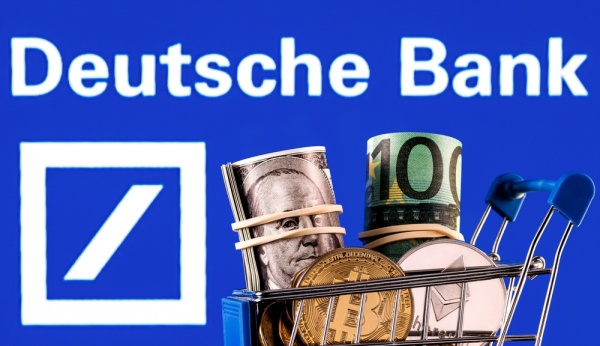
[Digital Today reporter Yoonseo Lee (이윤서)] Deutsche Bank (DB) analysed the recent sharp fall in bitcoin as the result of weakened trust rather than a market collapse.
On Feb. 5 (local time), CoinDesk, a blockchain media outlet, reported that the German investment bank pointed to three factors behind the decline: continued fund outflows by institutional investors, weakening links between bitcoin and traditional markets, and slowing regulatory momentum. Deutsche Bank said the current phase is a reset process, not a collapse, rather than a short-term shock.
Deutsche Bank said bitcoin has been called "digital gold" but its correlation with gold has weakened sharply this year. It said gold has risen more than 60 percent since 2025, supported by central bank buying and demand for safe-haven assets, while bitcoin has underperformed major assets, falling for several consecutive months. Deutsche Bank said bitcoin has fallen more than 40 percent from its peak in October 2025 and is showing a rare streak of consecutive declines since before and after the pandemic.
Institutional selling was presented as the most direct source of pressure. Deutsche Bank's analysis showed that U.S. spot bitcoin exchange-traded funds (ETFs) have continued to see outflows since October last year, with more than $7 billion leaving in November 2025. It also confirmed outflows of about $2 billion in December last year and more than $3 billion in January this year. Deutsche Bank said that as the institutional share declines, trading volume thins and prices can become more vulnerable to sharp swings.
Investor sentiment indicators also support the weakening. The crypto Fear and Greed Index has returned to the "extreme fear" level, and Deutsche Bank's own survey showed the share of U.S. consumers holding crypto fell from 17 percent in mid-2025 to about 12 percent recently.
Deutsche Bank also stressed that bitcoin is moving further away from familiar "market benchmarks". It said that after the gap with gold widened, correlation with the stock market has also dropped to the single digits to the mid-teens. It assessed that bitcoin is moving like an isolated asset as the previous pattern of moving in tandem with tech stocks during sharp drops driven by macro variables has weakened.
Regulatory uncertainty was also cited as a third negative factor. It said expectations for liquidity and volatility stability have weakened as discussion of the "CLARITY" bill has stalled in Congress due to differences over stablecoin provisions and other issues. Deutsche Bank pointed out that 30-day volatility in bitcoin has risen again to above 40 percent as a result.
Deutsche Bank added that the decline should not be interpreted excessively. It said bitcoin remains about 370 percent higher than in early 2023 even after the correction, suggesting that the speculative premium accumulated during the uptrend was considerable.
Separately, Citibank analysed that bitcoin is trading below the level of ETF costs and is nearing a pre-election price bottom as ETF inflows slow and headwinds accumulate.
 Yoonseo Lee
yslee@d-today.co.kr
Yoonseo Lee
yslee@d-today.co.kr