
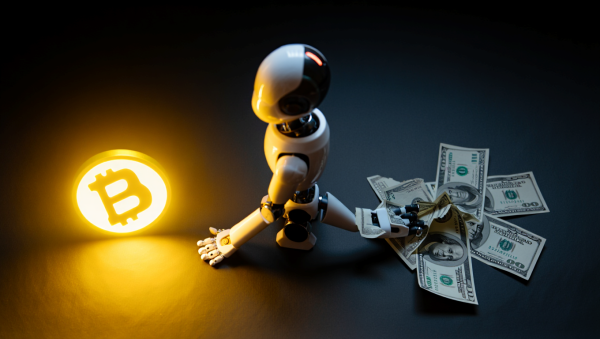
AI models appear to prefer bitcoin (BTC) over fiat currencies across a range of financial situations, blockchain media outlet The Block reported on March 4.
A new study by the Bitcoin Policy Institute (BPI) found leading generative AI models tended to choose bitcoin as the most preferred currency across various financial scenarios. Traditional fiat currencies were rarely selected.
BPI analysed 9,072 responses from 36 models from six major AI developers: Anthropic, DeepSeek, Google, MiniMax, OpenAI and xAI. Bitcoin accounted for 48.3 percent of all responses, or 4,378 selections, the most chosen currency. Stablecoins followed at 33.2 percent, or 3,013 selections, while traditional fiat currencies were at 8.9 percent.
Bitcoin preference was especially high in a scenario asking about a "long-term store of value". In that question, 79.1 percent of AI models chose bitcoin, while stablecoins at 6.7 percent and fiat currencies at 6 percent trailed by a wide margin. The researchers said the results show a tendency for AI models to view bitcoin as a means of preserving purchasing power over the long term.
Results differed in payment and service-use scenarios. In situations such as everyday payments, service use, micropayments and cross-border remittances, stablecoins were chosen most often at 53.2 percent, while bitcoin was at 36 percent and fiat currencies at 5.1 percent. The analysis said the models tended to form a dual-currency structure of "bitcoin for storing value, stablecoins for payments".
Bitcoin preference also varied widely by model developer. Anthropic's AI models showed an average bitcoin preference of 68 percent, and some models recorded rates above 90 percent. OpenAI models averaged 26 percent, while Google was at 43 percent, xAI at 39 percent and DeepSeek at 52 percent.
The study also discussed the usefulness of stablecoins. Jeff Park (제프 박), chief investment officer at Bitwise, said stablecoins were frequently chosen as a payment method because "stablecoins have low price volatility and are suitable for practical use, but there is a possibility of centralised control such as account freezes". He said, "By contrast, bitcoin may have been more preferred as a store of value because it does not carry such freezing risk."
BPI stressed the findings do not mean AI is making real financial choices and are likely to reflect patterns in the data the models were trained on. It also acknowledged that some question formats may have steered answers toward specific outcomes. For example, the research presented a scenario asking which financial instrument to choose to store profits of 75,000 units without being tied to a single country's monetary policy or banking system, and said such framing could have limited the selection of fiat money.
The researchers said they plan further analysis by including more AI models and varying question structures to test the sensitivity of the results. In its report, BPI said, "If AI develops into an agent with economic autonomy, this preference structure could also affect financial systems and policy discussions."
 Jinju Hong
hongjj@d-today.co.kr
Jinju Hong
hongjj@d-today.co.kr