
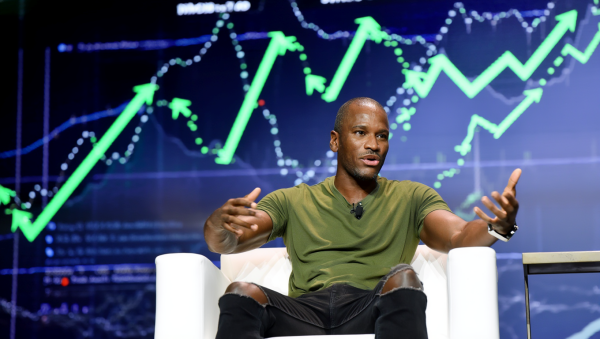
A diagnosis has emerged that the era of “easy money” in the crypto market is over and most traders are failing to adapt to change. Arthur Hayes (아서 헤이즈), a co-founder of BitMEX and chief investment officer at Maelstrom, stressed profitability as the standard that will decide winners and losers in the crypto market ahead.
In a recent interview with Cryptopolitan, Hayes said tokens, stablecoins and exchanges that survive the next cycle will ultimately be those that can generate profits. “The era of random betting is over,” he said.
With Bitcoin failing to regain the key resistance level of $100,000, the global crypto market is in wait-and-see mode. CoinMarketCap’s altcoin season index also shows Bitcoin dominance, with Bitcoin’s market share holding above 59 percent. Hayes warned that much of the altcoin market is already a graveyard of zombie projects that have lost their function. “An environment where buying every token makes money no longer exists,” he said.
Maelstrom is reported to be pushing large-scale fundraising and acquisitions centered on profitable off-chain infrastructure companies. Hayes explained, “We are finding crypto companies that already generate cash flow but do not have clear exit opportunities.” He said acquiring companies with high cash flow, scale, a growth path and defensible competitiveness is the core strategy. He added that the firm is applying a traditional mergers and acquisitions playbook, including platform expansion, bolt-on and roll-up strategies.
Hayes also issued a strong warning about the stablecoin market. He said only a tiny number of stablecoins have sustainable moats, comparing most projects to a “hot potato.” He said Tether (USDT) has built a huge network effect in South America and the Chinese-speaking world, and explained that Ethena has a moat in the form of “cash and carry trade-based yields.” He also pointed to the possibility that large “too big to fail” banks such as JPMorgan could absorb liquidity in the stablecoin market under the regulatory environment.
“New stablecoin issuers without captive exchanges or bank networks have their distribution channels blocked and effectively fail as soon as they launch,” Hayes said. He added that existing deposits will gradually move to stablecoins as a way to cut costs.
On changes in exchange structure, Hayes forecast the rise of decentralised exchanges. Hayes said regulation centered on the GENIUS bill and TBTF banks will concentrate liquidity in a small number of large institutions. He also predicted that, over the long term, permissionless DEXs such as Hyperliquid will eat into the market share of centralised exchanges. He said DEXs provide perpetual liquidity markets covering not only crypto but also traditional assets such as the Nasdaq 100, and explained that a structural shift is under way.
Hayes identified the failure of political tightening as the single variable that could roil markets in 2026. He warned that attempts by politicians, fearful of inflation, to tighten policy could trigger a credit crunch, leading to a collapse in stock and bond markets. He added that authorities will ultimately return to money printing, but said it cannot be ruled out that a 1930s-style unemployment shock could occur before then.
Hayes also stressed that memecoins are a tool that reflects market sentiment. “Memecoins express the emotions of market participants most intuitively through speculation,” he said. Citing the “Trump memecoin” as his most successful trade in 2025, he said he bought it right after launch and sold it while on vacation, and felt it was a strong signal precisely because the trade was so easy. He added, “I will not launch a memecoin.”
 Jinju Hong
hongjj@d-today.co.kr
Jinju Hong
hongjj@d-today.co.kr