
Could artificial intelligence-driven deflation push bitcoin up to $11 million? Joe Burnett (조 버넷) of bitcoin investment firm Strive argued that AI-led “technological deflation” would prolong central banks’ easy monetary policy and that liquidity expansion from that could lift bitcoin to $11 million by the first quarter of 2036.
Cointelegraph, a blockchain media outlet, reported on March 3 that Burnett, vice president of bitcoin strategy at Strive, said AI could boost productivity, increasing deflationary pressure across goods and services and squeezing corporate margins. He forecast that policymakers would be likely to prolong easy monetary policy to defend growth in such an environment.
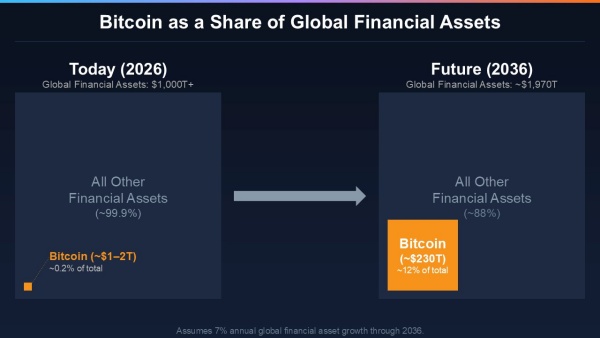
The forecast is based on aggressive assumptions. Burnett assumed a scenario in which global wealth increases at a 7 percent annual compound rate through 2036 and bitcoin accounts for about 12 percent of the value of global financial assets. Given bitcoin’s current share of financial assets is about 0.2 percent, bitcoin’s market value would need to expand more than 176 times over the next 10 years to reach $230 trillion for the scenario to be realised.
The price path is also steep. The target assumes a compound annual growth rate of about 53 percent through the first quarter of 2036. Burnett cited bitcoin’s average compound annual growth rate of about 60 percent from 2015 to 2024, but also noted that growth could slow as market value grows.
Burnett’s core logic rests on a structure he called an “AI deflation engine”. He argued that if AI automation and cost cuts create sustained deflationary pressure, credit markets could be shaken under a debt-based fiat currency system. He pointed out that “in a debt-based fiat currency system, sustained deflation destabilises credit markets because wages and asset prices fall while debts such as mortgages, corporate loans and government bonds are fixed in nominal terms.” As a result, he said, the likelihood grows that central banks and fiscal authorities will supply additional liquidity to prevent a deflationary vicious cycle.
Burnett also said a “digital credit” model pursued by some firms, including bitcoin-holding company Strategy, could accelerate bitcoin accumulation. If a structure spreads in which companies provide investors with dollar returns through listed securities backed by bitcoin reserves and use the funds raised to buy more bitcoin, he said a “reflexive feedback loop” could form between global demand for yield and bitcoin accumulation.
Still, the $11 million forecast far exceeds typical bullish scenarios. For example, asset manager Ark Invest has presented a 2030 bitcoin price range of $1.5 million in an optimistic case to $300,000 in a pessimistic case. The market has also pointed to the need to verify whether Burnett’s assumptions, including a 12 percent share of financial assets and global wealth growth, can realistically be met, and whether AI-driven deflation pressure would in fact lead to monetary easing and rising demand for bitcoin.
Good morning. Today I published the case for $11 million bitcoin by 2036.https://t.co/bybtTKa0C9 pic.twitter.com/fzfhXrS2nW
 Yoonseo Lee
yslee@d-today.co.kr
Yoonseo Lee
yslee@d-today.co.kr