
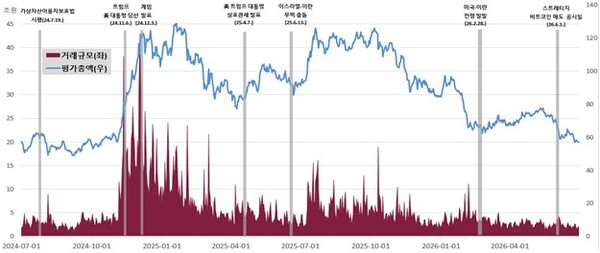
In the first half of this year, the market capitalisation and trading volume of South Korea's digital asset market both fell sharply. The number of users rose slightly, but won deposits and exchange profitability plunged.
A "2026 First-Half Survey on the Status of Digital Asset Service Providers" released on Wednesday by the Financial Intelligence Unit (FIU) and the Financial Supervisory Service showed that, as of end-June, the total valuation of digital assets in South Korea was 58.9 trillion won, down 33 percent from 87.2 trillion won at the end of last year. Over the same period, global digital asset market capitalisation also fell 28 percent.
Total digital asset trading volume in South Korea in the first half was 555 trillion won, down 44 percent from 1,001 trillion won in the second half of last year. Average daily trading volume fell to 3.1 trillion won from 5.4 trillion won.
Financial authorities assessed that the drop in bitcoin prices was a major factor, as risk-off sentiment strengthened amid wariness over the path of monetary policy in major countries, worsening market supply and demand conditions and expanding inflationary pressure stemming from war.
Won deposits also declined. As of end-June, won deposits stood at 5.2 trillion won, down 35 percent from 8.1 trillion won at the end of last year.
The market structure continued to be centred on the won market. The valuation of the coin market accounted for 0.6 percent of the total market, and the monthly turnover rate showed a wide gap, with the won market at 100 to 201 percent and the coin market at 2 to 9 percent.
By contrast, the number of tradable user accounts rose 0.4 percent to 11,175,000.
Among users, 77.2 percent were found to hold less than 1 million won in digital assets. Accounts holding 100 million won or more totalled 110,000, or 1 percent of the total, and their share fell 0.5 percentage point.
By age, people in their 40s accounted for the largest share at 26.9 percent. They were followed by those in their 30s at 26.7 percent, 50s at 20 percent, 20s and younger at 17 percent, and 60s and older at 9 percent. In the second half of last year, those in their 30s had the largest share at 26.8 percent, but in this survey those in their 40s led.
The market contraction also affected exchange results. Revenue at South Korean exchanges was 576.8 billion won in the first half, down 41 percent, and operating profit or loss was 81.6 billion won, down 78 percent.
The number of digital assets circulating in South Korea totalled 673, excluding duplicates, down 5 percent. Of these, 234 were single-listed digital assets supported for trading by only one exchange, down 21 percent.
The domestic valuation of single-listed digital assets was 600 billion won, about 1 percent of the total. Of these, 93 were tallied at 100 million won or less in valuation, and financial authorities pointed to the need to be mindful of low liquidity and sharp price fluctuations.
Listing and delisting trends also differed. New trading support in the first half totalled 135 cases, down 46 percent, while trading support terminations rose 64 percent to 108 cases. Designations as cautionary items also increased 46 percent to 139 cases.
The amount of digital assets transferred externally was 62.8 trillion won, down 41 percent. The amount subject to the travel rule, which applies to transfers between exchanges, fell 39 percent, while amounts transferred to overseas operators or personal wallets dropped 43 percent.
 Sang-yeop Oh
yub@d-today.co.kr
Sang-yeop Oh
yub@d-today.co.kr