
South Korea's financial authorities have begun a forced investigation into a so-called "information cartel" suspected of using non-public information related to tender offers and mergers and acquisitions (M&A) to gain more than 20 billion won in illicit profits.
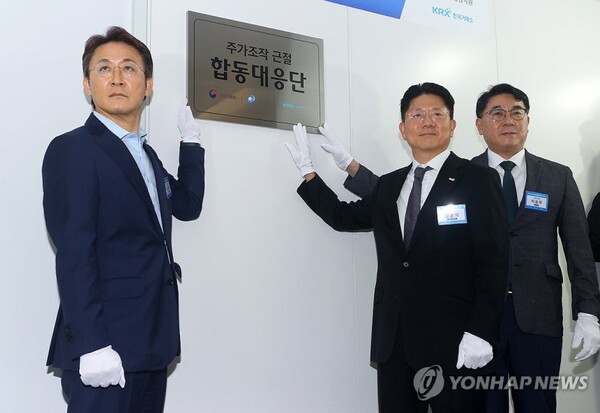
The joint response team to eradicate stock price manipulation, comprising the Financial Services Commission, the Financial Supervisory Service and the Korea Exchange, said on Sept. 29 it carried out search and seizure operations at about 20 locations, including suspects' homes and offices.
The Securities and Futures Commission also ordered payment suspensions under the Capital Markets Act on some suspects' brokerage accounts suspected of holding illicit gains obtained through the use of non-public information. The step is intended to prevent concealment or disposal of the gains and prepare for their recovery later.
According to the joint response team, the core suspects formed ties while participating together in a business club at a prestigious university and at a global consulting company. They later moved to jobs at private equity firms and listed companies, where they handled work related to tender offers and M&A.
They are suspected of continuously sharing positive non-public information on several listed companies that they learned in the course of their work over about the past 5 years.
Information on governance restructurings such as tender offers and M&A is material information that is likely to affect share prices after disclosure, and using it for stock trading before it is made public, or enabling others to use it, is prohibited under the Capital Markets Act.
Financial authorities believe the core suspects not only used the information in their own stock trading but also passed it to family members and acquaintances.
Suspects and their family members and acquaintances are believed to have made total illicit gains of more than 20 billion won by buying the related stocks before the information was disclosed to the market and selling them after share prices rose following disclosure.
Financial authorities are focusing on the point that this case was not a one-off use of non-public information by a specific individual, but involved repeated information sharing over a long period among professionals handling M&A work. The scope of those under suspicion also expanded as the information was passed on to family members and acquaintances.
The case was first detected during market surveillance by the Korea Exchange. Financial authorities said that in analysing cases of non-public information use in recent years, they confirmed the same suspects repeatedly appeared and have been investigating after combining related cases.
The joint response team said it has deployed investigators from relevant agencies since May to track how the information was obtained and the trading links, and plans to conduct additional probes based on materials secured in the raids.
Earlier, the joint response team carried out forced investigations including search and seizures into allegations that an executive at NH Investment & Securities, a tender offer underwriter, used non-public information in October last year, and it filed a complaint against the suspect in May.
The joint response team said it plans to analyse materials and evidence secured after the raids and payment suspensions to wrap up the investigation and, if allegations are confirmed, take follow-up steps including filing complaints and imposing penalties. The Capital Markets Act also allows penalties of up to twice the illicit gains.
 Oh Sang-yup
yub@d-today.co.kr
Oh Sang-yup
yub@d-today.co.kr