
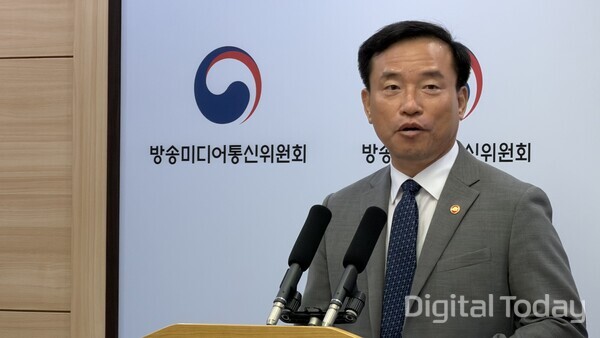
The Broadcasting Media Telecommunications Commission plans to shift its policy framework from a system centred on existing broadcasters and telecommunications operators to one centred on citizens' media rights. It views citizens not as simple media users but as media sovereigns, and aims for the government to build an institutional foundation so anyone can access, participate in and use media, and make choices in a safe environment.
The commission defines this as a "basic media society" and is moving to overhaul policies spanning regulation and promotion, from introducing media and AI vouchers to strengthening transparency for AI-generated content and recommendation algorithms, enacting an integrated media law and easing broadcast regulation.
The commission held its 39th plenary meeting on Sept. 30 and approved its "first-term vision and major measures". It presented "a basic media society with citizens" as its first-term vision in its first comprehensive policy blueprint since its launch in October last year.
The basic media society proposed by the commission refers to a society in which citizens' access, participation, use and enjoyment across the media ecosystem are guaranteed under the responsibility of the state and society. With digital and AI expansion making media a foundation for daily life beyond communication and content consumption to education, economic activity and social participation, it aims to ensure fundamental rights through media are also guaranteed in practical terms.
To this end, the commission set four goals and will 추진 12 policy tasks: strengthening universal access for all, expanding active participation led by citizens, guaranteeing autonomous choice based on safety and trust, and building a sustainable ecosystem of innovation and coexistence.
BROADCAST RULES EASED, NEW OTT AND AI REGULATION; INTEGRATED MEDIA LAW PUSHED
As policy shifts, the framework for regulating operators will also be reorganised. It will ease what it calls excessive prior regulation on existing broadcasting, while setting a basic regulatory framework for user rights protection for new types of media with growing influence, including OTT and platforms.
To do so, the commission will prepare by December this year an integrated media bill covering old and new media such as broadcasting and OTT and push legislation. It will review regulations introduced when media influence was concentrated in broadcasting, and introduce basic regulation for OTT commensurate with its social influence. It also plans to include in the integrated law an institutional foundation for fair competition between old and new media, and for promotion and coexistence.
It will significantly overhaul existing broadcast regulation. It will improve the terrestrial and general programming channels re-licensing and re-approval system and ease paid broadcasting rate and terms, and ownership and cross-ownership rules. It will seek to abolish programming rules that have become less effective, such as caps on entertainment programmes and on scheduling imported content from a single country. It plans to shift broadcast advertising and sponsorship to a negative regulatory system that is in principle allowed except for prohibited items.
In AI and platform areas, it will set new rules to strengthen users' right to know and choice. It will pursue a plan to impose on AI-generated content posters an obligation to label such content, and require portals and platforms to manage whether labeling is done. It will also pursue a system requiring disclosure of how recommendation algorithms work and major changes, and allowing users to choose whether and how algorithmic recommendations are applied.
Over the mid to long term, it will also review a separate regulatory framework covering AI service user protection obligations, rights guarantees and dispute mediation. Options include enacting a separate AI user protection law or adding related provisions to the Information and Communications Network Act.
REGULATION AND PROMOTION TOGETHER; EXPANSION OF MEDIA AND AI VOUCHERS
The commission said it will push regulation and promotion together so strengthening rules centred on citizens' rights does not lead to industry contraction.
Sung Jong-won (성종원), the commission's planning and coordination director, said at a briefing that it would proceed so the industry does not shrink by linking regulation and promotion, as a promotion function has been added rather than only regulation.
It will expand vouchers as a representative policy tool. It will support vulnerable groups such as older people, people with disabilities and farming and fishing communities with vouchers for paid generative AI services. It will also gradually shift the distribution of customised TVs for people with disabilities to a media use voucher approach that allows selection of needed media services by type of disability.
For young people in vulnerable groups, it will support subscription fees for AI and media content production software. For small and micro broadcasters, it will support the cost of introducing AI-based production and editing solutions through vouchers. For local broadcasters, it will introduce distribution vouchers that can be used for content translation and dubbing, marketing, and legal and contract matters.
It will also expand support for the broadcasting media industry's AI transformation. It will build training data for broadcast video AI and promote development of key technologies by production stage, including generative AI pre-visualisation, AI visual effects and digital humans, as well as support for actual broadcast content production. It will also expand legal consulting and publicity and marketing support for overseas expansion by domestic OTT services.
LEGISLATION, BUDGET AND MINISTRY ROLE-SHARING REMAIN FOLLOW-UP TASKS
Many tasks still require additional decisions on specific legislative approaches, budgets and role-sharing among relevant ministries.
For the integrated media law, it plans to prepare a bill by December this year and push legislation. Related lawmakers' bills have been proposed at the National Assembly, including an audiovisual media services law covering broadcasting and OTT. It is expected to be discussed and adjusted in the future parliamentary review process along with the government bill to be prepared by the commission.
Lee Ki-hoon (이기훈), head of the terrestrial broadcasting policy division, said the commission was also considering how to handle the broadcasting media market and related regulation and would prepare its own alternative separately from lawmaker Choi Min-hee.
AI regulation also faces an outstanding issue of consistency with the AI Basic Act handled by the Ministry of Science and ICT. Kim Jong-woo (김종우), head of the information integrity policy division, explained on AI-generated content labeling that it had agreed to continue discussions in cooperation with the ministry on the relationship and consistency with the AI Basic Act.
Many new promotion projects, including media and AI vouchers, have also not yet been reflected in the government's budget proposal. Sung said the commission views vouchers as an important tool for realising a basic media society and laid out a plan to expand related projects in stages through consultations with fiscal authorities and the National Assembly.
The launch timing for a Media Development Committee to discuss the integrated media law has also not been confirmed. Sung said discussions were continuing with relevant ministries including the Office for Government Policy Coordination, and that it was consulting to enable discussions through the committee centred on the integrated media law. On the possibility of a launch within the year, he said he could not give a definite answer but was working to push it as soon as possible.
Kim Jong-cheol (김종철), chairman of the commission, said the meaning of the vision was not in presenting a completed form of every policy but in clearly setting the direction the commission would move toward and its policy orientation, and in laying a cornerstone to develop it into concrete policies. "Today's vision is not completion but a start," he said.
 Seulgi Son
sageson@d-today.co.kr
Seulgi Son
sageson@d-today.co.kr