
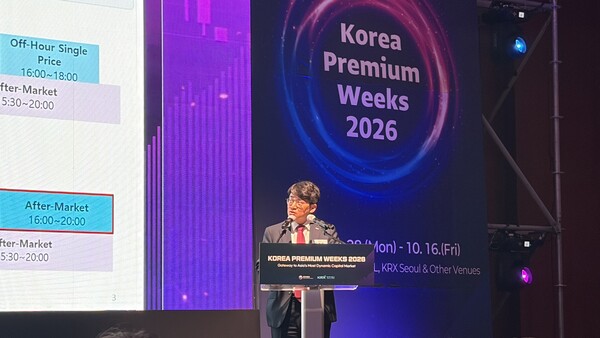
The Korea Exchange, after opening an after-market this month, plans to build a single-board system linking the premarket, main session and after-market by the end of 2027 and expand trading to 12 hours a day.
Jin Dong-hwa (진동화), managing director at the Korea Exchange's Stock Market Division, on Sept. 29 disclosed the after-market's operating status and plans to extend trading hours at 'Korea Premium Week 2026'.
The exchange has operated an after-market from 4 p.m. to 8 p.m., after the close of the main session, since Sept. 14. Trading covers KOSPI and KOSDAQ-listed shares, while exchange-traded funds and exchange-traded notes were excluded in consideration of initial market stability. The after-market applies the same price limits and volatility interruption mechanisms, as well as short-selling regulations, as the main session.
Initial trading reached a certain level. The after-market's average daily trading value in the first week after launch was about 110 billion won, or 4.6 percent of the main session. Thirty-seven of the exchange's 50 securities members took part. By investor type, individuals accounted for about 90 percent and foreigners about 6.7 percent. Actual trades occurred in 2,379 of the 2,763 eligible stocks.
Market volatility is also easing from the opening stage. The number of volatility interruption triggers in the after-market reached 1,112 on the first day but later fell to about 553. Volatility between daily highs and lows was also lower than in the main session for five consecutive trading days, the exchange said.
The next step is introducing a premarket and a single board. The exchange currently operates the after-hours market and the main session on separate boards, requiring brokers to cancel unfilled orders when the market changes.
The exchange plans to address this by building, by the end of 2027, a single-board infrastructure that would allow unfilled orders to remain valid across the premarket, main session and after-market.
Alongside the single board, it is also pushing to open a premarket before the main session to increase total trading hours to 12 a day. The specific opening and closing times for the premarket have not been set and will be decided through consultations with financial authorities.
It also left open the possibility of switching to 24-hour trading. The exchange plans to first establish an internal systems environment that could later be expanded to 24-hour trading through the single-board buildout.
It said the timing of full adoption would be reviewed separately, as broader night trading could raise staffing, labour and risk management costs for market participants including brokerages and asset managers.
Jin said the timing for full adoption of a 24-hour system should be decided prudently after the premarket and after-market and the single board become established. He said the exchange would pursue the changes in stages, reflecting global exchanges' progress in extending trading hours and shortening settlement cycles, as well as feedback from market participants.
Work is also under way to shorten the stock settlement cycle from two business days after the trade date (T+2) to one business day (T+1), alongside the trading-hours expansion.
According to the Financial Services Commission, a working group on shortening the settlement cycle, involving the Korea Exchange, Korea Securities Depository and the Korea Financial Investment Association, plans to draw up a detailed roadmap targeting October.
Global markets are also speeding up changes to trading and settlement infrastructure. The United States switched to a T+1 settlement system in May 2024, and Hong Kong Exchanges and Clearing is also pushing to introduce T+1.
Yoo Tae-seok (유태석), managing director at Hong Kong Exchanges and Clearing, said in a presentation on the day that it is pushing to shift its settlement system from batch processing to real-time settlement and build a system that lets investors directly check settlement progress.
Nasdaq is also pushing to expand market access regardless of time zone. Bob Mccooey (Bob Mccooey), a vice chairman at Nasdaq, said, "Information, risks and capital keep moving regardless of time zones." He stressed that expanding trading hours is not simply about keeping markets open longer, but about modernising market infrastructure for global investors.
With the extension of trading hours and the shift to T+1 being pursued at the same time domestically, the burden of system overhauls for brokerages and custodians is expected to grow.
In particular, with back-office tasks such as foreign investors' currency conversion and settlement instructions and stock lending needing to be processed in a shorter time, overhauling not only trading hours but also clearing and settlement and overall risk management systems is likely to emerge as a key task in reshaping domestic stock market infrastructure.
 Sang-yeop Oh
yub@d-today.co.kr
Sang-yeop Oh
yub@d-today.co.kr